Will a Skid Plate Affect Cooling, Noise or Vehicle Service?
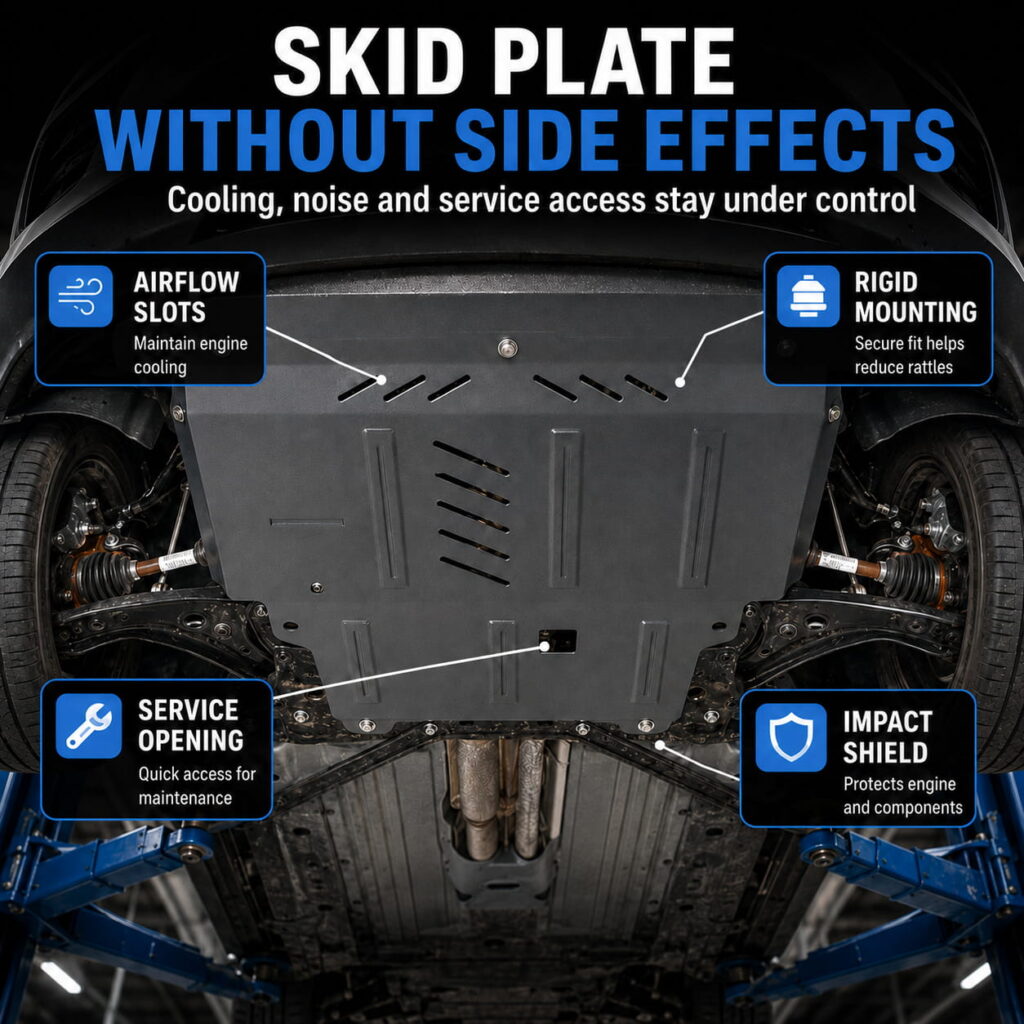
A skid plate should protect the exposed component without creating a new problem. If it causes rattling, vibration, overheating risk, blocked service access or poor drainage, the cause is usually incorrect fitment, poor clearance, weak mounting or the wrong skid plate for the vehicle version.
Use this checklist before and after installation.
Quick Technical Check
| Risk | Typical cause | Correct condition |
|---|---|---|
| Cooling issue | Blocked airflow around engine, radiator or gearbox area | Ventilation and clearance remain open where needed |
| Rattling | Loose hardware, missing spacer or contact with exhaust/bracket | The skid plate is fixed firmly and does not touch nearby parts |
| Vibration | Skid plate forced into position or mounted under tension | Mounting holes align naturally before tightening |
| Blocked service | Oil drain, filter or inspection point covered without access | Service opening, removable cover or easy skid plate removal |
| Dirt buildup | Flat tray-like skid plate shape with poor drainage | Drain holes, open edges or cleaning access are present |
| Poor fitment | Wrong engine, drivetrain, model year or body version | Fitment matches the exact model year, drivetrain and protected component area |
Cooling: What Must Stay Clear
A skid plate can affect cooling if it blocks airflow or sits too close to hot components. The critical areas are the lower engine bay, radiator support, gearbox and exhaust zone.
Check:
- ventilation slots where the engine or radiator area needs airflow;
- clearance from oil pan, gearbox and exhaust;
- factory air guides not removed or blocked incorrectly;
- openings not blocked by mud, snow or debris;
- skid plate shape following the original underbody layout.
A solid flat skid plate under the wrong area may protect from impact but create heat and airflow problems.
Vehicle-specific fitment is particularly important when one front plate covers several connected areas. Our Mazda CX-5 skid plate guide explains the available 2 mm steel protection for the catalogue-listed engine, gearbox and radiator zone and the installation checks required before fitting.
For a broader explanation of when the lower radiator area needs dedicated protection, see our radiator skid plate guide, including lower-front exposure, road-impact risks and vehicle-specific coverage.
Noise and Rattle
A correctly installed skid plate should not rattle. Noise usually means movement, missing hardware or contact with another part.
Inspect:
- bolt tightness;
- correct bolt length;
- washers, spacers and brackets;
- contact with exhaust, subframe or suspension parts;
- stones trapped between the skid plate and underbody;
- unevenly loaded mounting points.
After installation, the skid plate should not move by hand.
Vibration
Vibration often appears when the skid plate almost fits, but not correctly. “Almost fits” is not acceptable for underbody protection.
Warning signs:
- mounting holes do not align before tightening;
- the skid plate must be bent, drilled or forced;
- one bracket is under tension;
- the skid plate touches the gearbox, exhaust or engine movement area;
- the product is for a different engine, drivetrain or facelift version.
A correct skid plate should sit in position before final tightening.
Service Access
An engine skid plate may sit under the oil drain plug, oil filter or inspection area. That does not automatically mean bad design.
Acceptable solutions:
- oil drain service opening;
- removable service cover;
- full skid plate removal during maintenance.
Removing the skid plate during service is acceptable if it can be removed and reinstalled easily. Bad design is when access is blocked and removal is difficult because of poor mounting or hardware position.
A vehicle-specific example is the Hyundai Elantra underbody protection guide. The available 2 mm steel plate for 2021–2026 models is listed without an oil sump opening, so removal may be required for some oil-change or service procedures. This is acceptable when the plate uses accessible mounting points and can be correctly removed and reinstalled.
The Mitsubishi ASX provides another useful service-access example. Our Mitsubishi ASX underbody protection guide compares the 2010–2022 steel plate with an oil-sump opening against the 2023–2026 version without one, showing why service access should be checked separately for each vehicle application.
For the earlier application, see the Mitsubishi ASX 2010–2022 engine and gearbox steel skid plate, which is listed with an oil-sump service opening.
For a detailed comparison of the two vehicle applications, including mounting differences, service access and why the 2010–2022 and 2023–2026 skid plates are not interchangeable, see our Mitsubishi ASX skid plate fitment guide.
For owners deciding which areas deserve protection first, our Mitsubishi ASX protection priorities guide explains the practical order of engine, gearbox and radiator protection by model year.
Commercial vans also require careful checks because several skid plates may be listed for overlapping production years while using different designs, materials or SKUs. Our Volkswagen Transporter T5, T6 and T6.1 underbody protection guide compares the available applications and explains why the exact generation, production year and vehicle configuration must be confirmed before installation.
The same fitment principle applies to the Ford Transit Custom, where different plates cover the engine, gearbox, radiator or AdBlue tank. Our Ford Transit Custom underbody protection guide compares the listed protection zones and model-year applications from 2013 to 2026.
Drainage and Cleaning
A skid plate should not hold water, mud, salt or snow against the vehicle.
Check:
- drain holes;
- open edges where water can escape;
- no closed pockets that hold mud;
- cleaning access after heavy mud or snow;
- drainage openings not blocked by brackets.
Drainage is part of skid plate design, not an optional detail.
Ground Clearance
A skid plate adds material under the vehicle, but it should not hang lower than necessary.
Good design:
- the skid plate sits close to the protected component;
- it protects the lowest vulnerable area;
- the front edge does not easily catch obstacles;
- it does not create a new low point without reason.
A skid plate that reduces clearance but leaves the vulnerable part exposed is the wrong design.
Hybrid Vehicles
Hybrid and mild-hybrid vehicles need extra fitment checks because the underbody may include battery covers, cooling lines, high-voltage cable areas, different exhaust routing or rear drivetrain components.
A hybrid or mild-hybrid skid plate must not:
- press against battery-related covers;
- touch electrical cables or protected connection areas;
- block cooling or drainage paths;
- hide required service or inspection areas;
- be adapted from a petrol or diesel version unless compatibility with the exact electrified powertrain is confirmed.
Separate products may be required even when the body style and production years appear identical. Our Hyundai i20 underbody protection guide shows why the standard 2021–2026 application and the dedicated 48V mild-hybrid application must be checked independently.
A concrete hybrid-specific example is the Hyundai i20 Hybrid 2021–2026 engine, front bumper, gearbox and radiator skid plate, which is listed separately for the electrified application.
Fully electric vehicles also require correct clearance, cooling, drainage and service access around the protected front underbody area. Our Volkswagen ID.4 steel vs aluminium skid plate guide compares the available 2 mm steel and 3 mm aluminium protection and explains why a front skid plate must not be confused with a complete traction-battery shield.
Another fully electric example is the Tesla Model Y front and rear electric motor skid plate guide. It explains why the front and rear drive units require separate protection and why motor skid plates should not be confused with full traction-battery protection.
Always confirm the VIN, exact model year, drivetrain, electrified powertrain type, protected component area and underbody mounting layout before ordering.
Before Installation
- Confirm model, year, engine and drivetrain.
- Confirm petrol, diesel, hybrid or electric version.
- Confirm protected area: engine, gearbox, radiator, fuel tank, battery or differential.
- Check that all brackets, bolts, washers and spacers are present.
- Hold the skid plate in position before tightening.
- Mounting holes should align naturally.
- Check clearance around exhaust, steering, suspension, gearbox and engine movement areas.
After Installation
- No rattle at idle.
- No vibration during acceleration, braking or turning.
- No contact with exhaust or drivetrain after engine movement.
- No abnormal temperature behaviour in normal driving.
- No loose bolts after a short test drive.
- No blocked ventilation or drainage openings.
- Service access is possible, or the skid plate can be removed easily.
Normal vs Not Normal
| Normal | Not normal |
|---|---|
| Removing the skid plate during oil service | The skid plate is difficult to remove or reinstall |
| Small local clearance change | The skid plate hangs lower than necessary |
| Drainage openings collect some dirt | Mud or water stays trapped with no escape path |
| Firm mounting to correct points | Rattling, vibration or contact with exhaust/drivetrain |
| Ventilation placed by function | Solid skid plate blocks radiator or engine airflow area |
Conclusion
A skid plate should not cause cooling, noise, vibration or service problems when it matches the exact vehicle and is installed correctly.
Most issues come from wrong fitment, universal skid plates, missing hardware, blocked airflow, poor drainage or contact with nearby components.
Choose underbody protection by vehicle version, drivetrain, protected component area and mounting layout. If fitment is uncertain, check compatibility before ordering.
If you are deciding whether engine-only protection is enough or whether the vehicle needs broader coverage, see our engine skid plate vs full underbody protection guide.
Find the Correct Skid Plate
Browse vehicle-specific skid plates by brand, model and year: Shop by Vehicle.
Not sure which skid plate fits your vehicle? Use our VIN check page: Check Compatibility by VIN.
FAQ
Can a skid plate cause overheating?
Yes, if it blocks required airflow or sits too close to hot components. Correct fitment, ventilation and clearance reduce this risk.
Why does a skid plate rattle?
Rattling usually comes from loose bolts, missing spacers, trapped stones, poor alignment or contact with exhaust, subframe or suspension parts.
Should a skid plate touch the oil pan or gearbox?
No. A skid plate should protect the component, not press against it. Proper clearance is required.
Is removing the skid plate during oil service a problem?
No. Some skid plates are removed during service. This is acceptable if removal and reinstallation are simple.
Are universal skid plates risky?
Yes. Universal skid plates can create problems with mounting, clearance, airflow, drainage and service access because each vehicle underbody is different.
