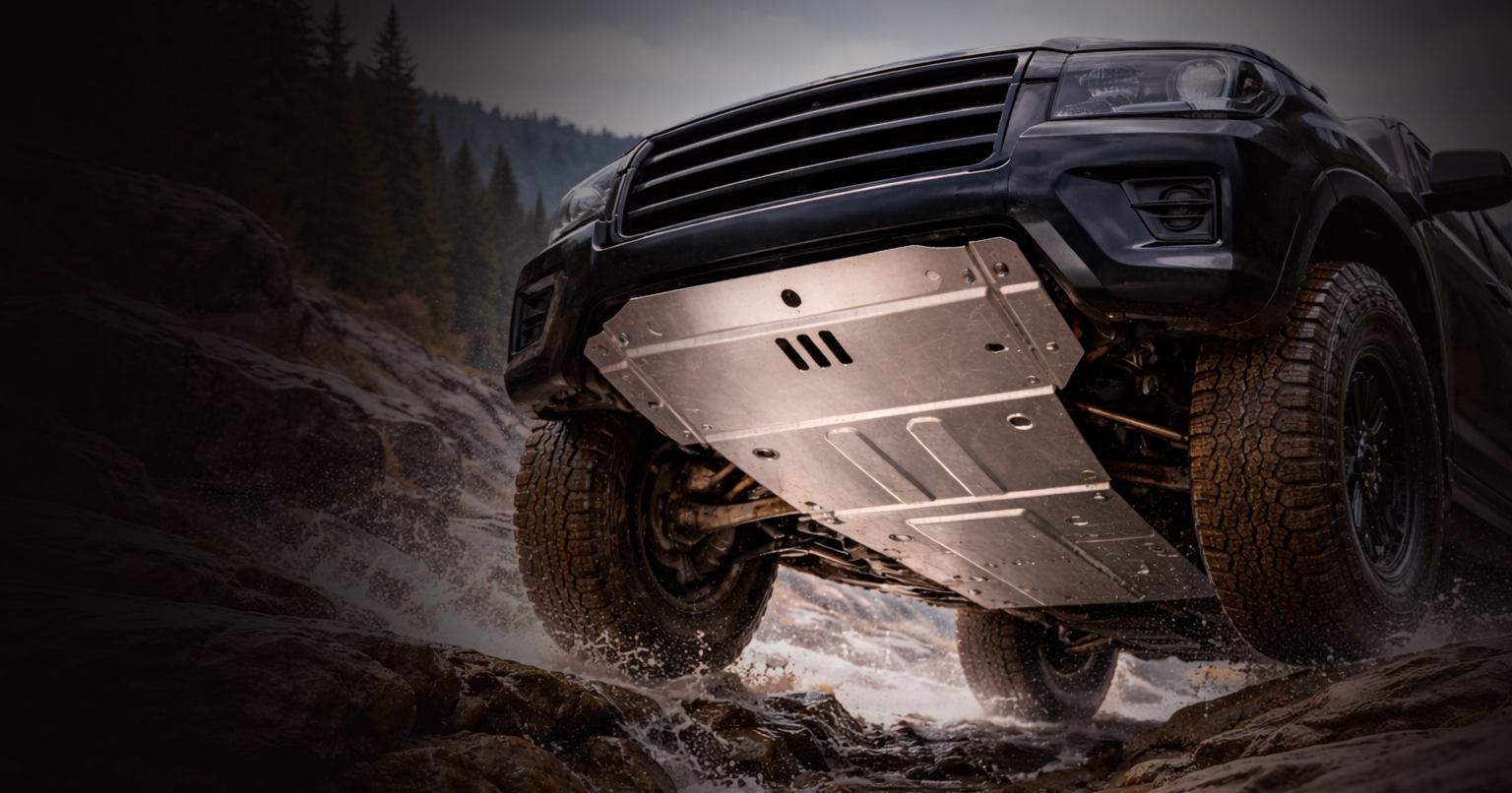
Toyota Land Cruiser 250 Radiator Protection: Is It Worth It?
The Toyota Land Cruiser 250 is designed for demanding use, but the radiator area remains exposed to a different type of risk than the engine, gearbox or transfer case. An engine skid plate protects components farther behind the front bumper; it does not automatically create a barrier beneath the lower cooling area.
This distinction matters when the vehicle is driven over loose rocks, frozen snow, deep ruts, forestry tracks or construction-site debris. A relatively small object can enter beneath the front of the vehicle before the wheels have a chance to pass around it.
Short answer: radiator protection is worthwhile when an LC250 regularly leaves smooth paved roads, encounters compacted snow or debris, or travels in places where cooling-system damage would leave the vehicle difficult or expensive to recover. For an LC250 used almost entirely on well-maintained roads, it is a lower priority than for a vehicle used on gravel, worksites or off-road routes.
What Does an LC250 Radiator Skid Plate Actually Protect?
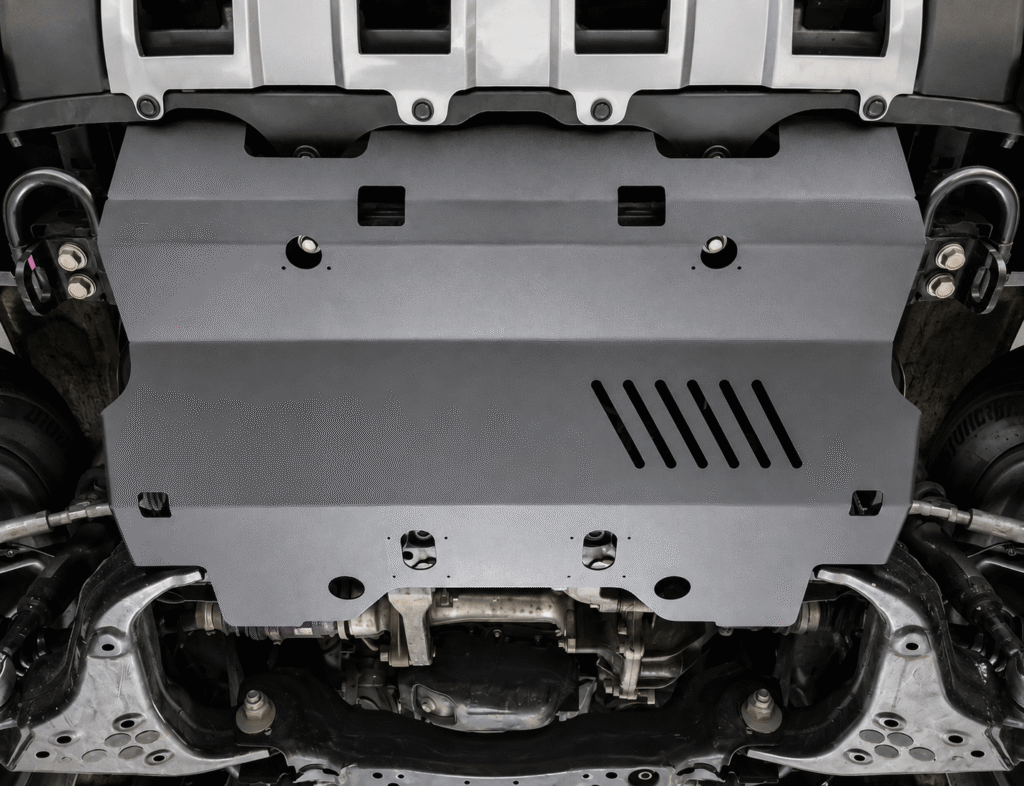
A radiator skid plate is positioned beneath the front cooling area. Its purpose is to create a rigid barrier between vulnerable lower components and objects approaching from below.
It should not be confused with a grille guard or a complete engine shield. It does not protect against every frontal impact, and it does not seal the cooling pack from mud, water or fine debris. Its job is more specific: reducing the chance that a rock, hard ridge, block of ice or road debris reaches the lower radiator area directly from underneath.
UnderbodyGuards lists two vehicle-specific options for this zone:
- Toyota Land Cruiser 250 radiator skid plate – 3 mm steel
- Toyota Land Cruiser 250 radiator skid plate – 4 mm aluminium
Both versions are listed for Toyota Land Cruiser 250 model years 2024–2026, all engine variants, and a product weight of 10 kg. Exact compatibility should still be confirmed against the VIN, market specification and underbody layout before ordering.
How an Object Reaches the Cooling Area from Below
The radiator zone is close to the leading edge of the underbody. That changes the way it encounters obstacles.
Loose rocks and road debris
A stone kicked up by another vehicle, a broken piece of road material or debris on a worksite can strike the lower front area before it passes beneath the engine. The object does not need to be large enough to stop the vehicle; concentrated contact at the wrong point can still cause damage.
Frozen snow and ice
Compacted winter material can behave more like a solid obstacle than soft snow. Frozen ridges left between lanes, chunks falling from other vehicles and hard snowbanks can all load the lower front edge.
Deep ruts and abrupt transitions
When the front of the LC250 drops into a rut or approaches a sharp rise, the lower front zone can contact the ground before the centre of the vehicle reaches the same obstacle. This is why radiator protection and centre-drivetrain protection solve different problems.
Forestry tracks and worksites
Branches, embedded stones, broken concrete and scrap material are less predictable than a uniform gravel surface. The risk comes from their shape and position, not only from vehicle speed.
Why Cooling-System Damage Can Stop the Journey Quickly
Damage to a conventional skid plate may allow the vehicle to continue after inspection. Cooling-system damage is different. If an impact causes coolant loss or restricts cooling performance, continued driving can turn a localised front-underbody strike into an overheating event.
If that warning appears after an impact, the vehicle should not simply be driven until the next convenient stop.
After any significant strike beneath the front of the vehicle, check for:
- fresh coolant or an unexplained wet area beneath the front;
- a coolant smell, steam or an abnormal rise in temperature;
- a warning message or high coolant temperature warning;
- visible deformation around the lower cooling area;
- a skid plate pushed into a component behind it;
- loose, missing or shifted fasteners.
Do not remove a coolant-system cap while the system is hot. If leakage, steam or an overheating warning is present, stop safely and arrange an inspection before continuing.
Radiator Protection and Engine Protection Are Not the Same
| Protection zone | Primary purpose | What it does not automatically cover |
|---|---|---|
| Radiator area | Helps block impacts entering beneath the lower front cooling zone | Engine, front differential, gearbox and transfer case |
| Engine and front differential area | Creates a barrier beneath the engine and, on the relevant version, the front differential | Lower radiator area and centre drivetrain |
| Gearbox and transfer-case area | Protects the centre drivetrain after an obstacle passes the front axle area | Radiator and engine areas |
This separation is the main reason a buyer should choose protection by zone rather than assuming that one large-looking front plate covers the complete underbody.
When Is Radiator Protection Worth It?
Regular gravel-road use
Radiator protection is a sensible front-zone upgrade when gravel roads form a normal part of the vehicle’s use. The issue is not only continuous small stone spray; occasional larger objects and damaged road sections create the more serious risk.
Winter roads with compacted snow and ice
Drivers who frequently encounter frozen ruts, hard snowbanks or ice debris have a stronger case for radiator protection than drivers using cleared urban roads. The plate also requires winter inspection because salt, trapped dirt and fasteners still need attention.
Forestry roads, farms and worksites
These environments combine uneven ground with branches, stones and construction debris. A radiator plate is usually justified even when the vehicle is not used for recreational off-roading.
Off-road and overland travel
For remote travel, the consequence of cooling-system damage matters as much as the likelihood of impact. A problem that might require a short recovery near a city becomes much more serious far from a workshop.
Mainly smooth-road use
If the LC250 stays on maintained paved roads and rarely encounters snow ridges, loose debris or uneven access roads, a separate radiator plate is optional rather than urgent. The decision should be based on actual routes, not the vehicle’s off-road image alone.
3 mm Steel or 4 mm Aluminium?
For these two LC250 radiator plates, material should not be chosen on the assumption that aluminium is lighter. Both product pages list a weight of 10 kg.
The practical choice is therefore:
- Choose 3 mm steel when resistance to repeated concentrated contact is the main priority and periodic coating inspection is acceptable.
- Choose 4 mm aluminium when corrosion resistance is the stronger priority, especially in wet or salted environments, while recognising that brackets and fasteners still require inspection.
Thickness figures alone do not establish which finished plate is stronger. Shape, bends, unsupported span, mounting points and load transfer all affect performance. For a deeper material comparison, see the Toyota Land Cruiser 250 steel vs aluminium skid plate guide.
Individual Radiator Plate or Complete Protection Set?
An individual radiator plate is appropriate when the lower cooling area is the immediate priority and the vehicle does not yet require wider underbody coverage. It also allows the owner to build protection by zone.
A complete set is the more coherent choice when the same LC250 regularly encounters obstacles that can continue beneath the engine, front differential, gearbox and transfer case. UnderbodyGuards lists complete systems in both 3 mm steel and 4 mm aluminium.
The individual-versus-complete decision should be based on exposed zones and intended use, not simply on the number of plates in the package.
Recommended Configuration by Use
| Typical use | Radiator-protection priority | Practical approach |
|---|---|---|
| Maintained city and motorway driving | Low to moderate | Inspect the existing lower front area and add protection if routes include debris, winter ridges or damaged roads |
| Regular gravel and rural roads | High | Individual radiator plate is a logical first front-zone upgrade |
| Winter roads with hard snow and ice | High | Radiator protection plus regular corrosion, clearance and fastener inspection |
| Forestry tracks and worksites | High | Radiator plate at minimum; extend coverage according to the rest of the exposed route beneath the vehicle |
| Frequent off-road or remote overland travel | Very high | Complete underbody protection is usually more appropriate than treating the radiator as an isolated risk |
Fitment, Airflow and Installation Checks
A radiator skid plate must match the vehicle’s mounting points and lower-front layout. The listed steel and aluminium plates are supplied with mounting hardware and an installation manual, but compatibility should still be confirmed before fitting.
Before ordering, verify:
- VIN and model year;
- engine and drivetrain configuration;
- market specification and body version;
- existing factory or aftermarket underbody parts;
- whether another skid plate uses the same mounting area.
During installation, use the specified hardware and mounting sequence. Do not improvise by covering designed openings or forcing a plate against surrounding components. After fitting, confirm clearance, secure fasteners and check that nothing contacts the plate during normal vehicle movement.
If the exact configuration is uncertain, use the GuardPass VIN compatibility check before ordering.
Inspection After an Underbody Strike
A skid plate is a load-bearing barrier, not a maintenance-free cover. After a significant impact:
- Stop in a safe location and check for coolant, warning messages, steam or unusual smells.
- Inspect the plate for deformation and displaced fasteners.
- Confirm that the plate has not been pushed into the protected area.
- Check adjoining plates because an impact can transfer load into shared mounting points.
- Have the vehicle inspected if there is any sign of leakage, overheating or structural movement.
A scratched plate may have done its job. A bent plate, loose mounting point or reduced clearance requires attention before the next demanding journey.
Final Recommendation
Radiator protection is worth installing on an LC250 that regularly uses gravel roads, winter routes, forestry tracks, worksites or off-road trails. It addresses the leading underbody zone, where an obstacle can reach the cooling area before it passes beneath the engine or centre drivetrain.
For mainly smooth-road use, it remains an optional risk-reduction upgrade. For frequent rough-road or remote travel, it should be considered part of a complete protection strategy rather than a substitute for engine, differential, gearbox and transfer-case coverage.
Toyota Land Cruiser 250 Radiator Protection FAQ
Does an LC250 engine skid plate also protect the radiator?
Not automatically. The radiator and engine occupy different protection zones. Confirm the stated coverage of the exact plate rather than judging by its overall size.
Does a radiator skid plate protect the front grille?
No. It is intended to reduce impact exposure from below. It is not a grille guard and cannot prevent every frontal strike.
Which LC250 radiator plate is lighter?
Neither according to the current product specifications. Both the 3 mm steel and 4 mm aluminium radiator plates are listed at 10 kg.
Is 4 mm aluminium automatically stronger than 3 mm steel?
No. Thickness cannot be compared without considering material properties, plate geometry, reinforcement and mounting design.
Are the radiator plates listed for all LC250 engines?
Both versions are listed for all engine variants for model years 2024–2026. VIN, market specification and exact underbody layout should still be checked before ordering.
Should I choose an individual radiator plate or a complete set?
Choose the individual plate when the radiator area is the immediate priority. Choose a complete set when the vehicle’s routes also expose the engine, front differential, gearbox and transfer case to impacts.
What should I inspect after the radiator skid plate hits an obstacle?
Check the plate, fasteners, mounting points, clearance behind the plate and the cooling system for any sign of leakage or overheating.
