Toyota Land Cruiser 250 Steel vs Aluminium Skid Plates: Which Should You Choose?
Choosing between steel and aluminium underbody protection for the Toyota Land Cruiser 250 is not simply a question of which material is stronger. The correct choice depends on the type of impacts the vehicle is likely to encounter, how often it leaves maintained roads, how much additional equipment it carries and which underbody zones the selected plates actually cover.
For the 2024–2026 LC250, UnderbodyGuards offers 3 mm steel and 4 mm aluminium protection for the radiator, engine, gearbox and transfer-case areas. The two complete systems cover the same four principal zones, but they differ in weight, corrosion behaviour and the way they respond to repeated contact with rocks, ruts and hard road edges.
This guide compares the two materials specifically for the Toyota Land Cruiser 250. For a broader explanation of which components should be protected first, read the Toyota Land Cruiser 250 complete protection guide.
Protection priorities also depend on the component being covered. See our guides to engine and front differential protection and Toyota Land Cruiser 250 radiator protection.
Short Answer: Steel or Aluminium for the LC250?
Choose 3 mm steel if the LC250 is regularly used on rocky tracks, deep ruts, construction or forestry roads, or terrain where repeated hard contact is expected. Steel is the more conservative choice when resistance to severe localised impacts is the main priority and additional weight is acceptable.
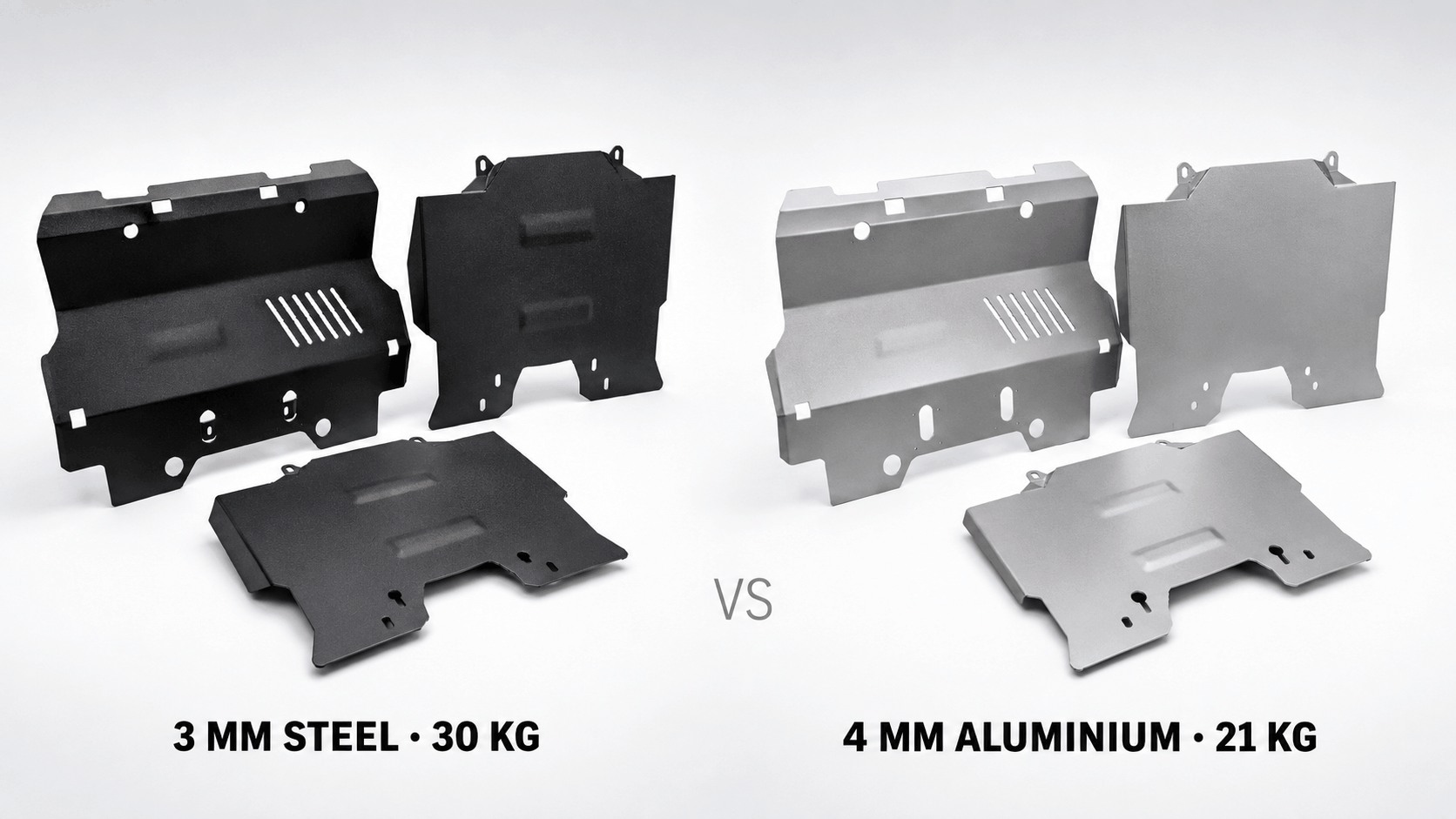
Choose 4 mm aluminium if the vehicle is used for mixed road and off-road driving, winter travel, gravel routes or overlanding where corrosion resistance and total accessory weight matter. The complete aluminium system is approximately 9 kg lighter than the comparable steel system while protecting the same four principal areas.
| LC250 comparison | 3 mm steel | 4 mm aluminium |
|---|---|---|
| Complete-set weight | Approximately 30 kg | Approximately 21 kg |
| Listed complete-set coverage | Engine, radiator, gearbox and transfer case | Engine, radiator, gearbox and transfer case |
| Best suited to | Repeated hard impacts, rocky terrain and demanding work use | Mixed driving, winter roads, gravel and weight-conscious overland builds |
| Corrosion considerations | Relies on its protective coating and periodic inspection | Does not rust, although the complete assembly and steel brackets still require inspection |
| Typical impact behaviour | Higher resistance to repeated concentrated contact | Lower mass and good coverage, but may deform sooner under severe concentrated impacts |
| Oil sump opening | No | No |
Why 4 mm Aluminium Is Not Automatically Stronger Than 3 mm Steel
Thickness figures cannot be compared without considering the material. Four millimetres of aluminium is not automatically stronger than three millimetres of steel simply because the number is larger. Steel and aluminium have different stiffness, yield behaviour, density and resistance to localised deformation.
The finished skid plate is also more than a flat sheet. Its performance depends on:
- the shape and unsupported span of the plate;
- pressed ribs, bends and external reinforcement;
- the position and strength of the mounting points;
- the brackets and fastening hardware;
- clearance between the plate and the protected component;
- how impact loads are transferred into the vehicle structure.
A well-reinforced aluminium plate can provide effective protection while saving weight. A steel plate of the same general size will normally tolerate repeated hard and concentrated contact better, but it adds more mass. The correct comparison is therefore complete design versus complete design, not 3 mm versus 4 mm in isolation.
For a general material comparison covering different vehicle types, see the steel vs aluminium skid plate guide.
The LC250 Weight Difference: 30 kg vs 21 kg
The complete 3 mm steel LC250 protection set weighs approximately 30 kg. The corresponding 4 mm aluminium set weighs approximately 21 kg. Aluminium therefore saves about 9 kg across the complete three-piece system, or roughly 30% of the steel kit’s weight.
Nine kilograms is not a dramatic change on an otherwise standard Land Cruiser 250. It becomes more relevant when the vehicle also carries a winch, steel bumper, roof rack, rooftop tent, recovery equipment, tools, water, luggage and additional passengers. Every accessory consumes part of the vehicle’s available payload and contributes to axle load.
This is why aluminium can make sense for a heavily equipped touring vehicle even when the owner is not trying to build the lightest possible LC250. The weight saving can be allocated to equipment that is more difficult to omit. Steel remains rational when the protection system itself has priority over saving those 9 kg.
The stated figures refer to the protection systems themselves; packaged shipping weight may be slightly higher.
Coverage Matters More Than the Material Name
The complete steel and aluminium sets are both listed as protecting the engine, radiator, gearbox and transfer-case areas. However, individual front plates do not always have identical listed coverage.
The 3 mm steel engine and front differential skid plate explicitly includes the front differential area. The 4 mm aluminium engine skid plate is listed for the engine area.
That difference is more important than the material thickness when front-differential protection is required. Never assume that two plates cover the same components because they fit the same vehicle or appear similar in a product image. Compare the protection zones stated on the individual product page and confirm the exact configuration before ordering.
How 3 mm Steel Behaves in Demanding Use
Steel is generally the stronger choice for an LC250 that frequently makes underbody contact with rocks, hard ruts or raised centre sections. Its main advantage is resistance to concentrated loads and repeated impacts. When the vehicle’s weight comes down onto a relatively small contact point, material toughness and the reinforced shape of the plate become more important than protection against loose debris alone.
Steel is particularly suitable when:
- the vehicle regularly travels on rocky or deeply rutted tracks;
- underbody contact is expected rather than merely possible;
- the LC250 is used on construction sites, forestry roads or agricultural routes;
- the vehicle carries heavy loads over uneven terrain;
- maximum resistance to repeated localised impacts is more important than saving weight.
The trade-off is mass and coating maintenance. Powder coating creates a protective barrier, but rock contact can expose the steel beneath it. Damage should be cleaned and treated before corrosion spreads under the surrounding coating. Mud and road salt should also be removed after winter or off-road use.
For maximum front-to-centre coverage in these conditions, see the Toyota Land Cruiser 250 complete 3 mm steel skid plate set.
How 4 mm Aluminium Behaves in Mixed and Overland Use
Aluminium is attractive when broad protection is required without adding the full mass of a steel system. It does not rust, which is useful for vehicles exposed to salted winter roads, wet gravel, mud and frequent changes between road and off-road conditions.
Aluminium is particularly suitable when:
- the vehicle spends most of its time on paved roads, gravel and moderate trails;
- the build already includes touring, recovery or camping equipment;
- lower total accessory weight is a priority;
- the LC250 is driven regularly in wet, coastal or salted-road conditions;
- the expected hazards are road debris, snow, washouts and occasional underbody contact rather than repeated rock strikes.
Aluminium can still deform during a severe concentrated impact. That is not automatically a failure: controlled deformation may absorb energy before it reaches the protected component. The plate must nevertheless be inspected afterwards for reduced clearance, contact with the drivetrain, stretched mounting holes or damaged brackets.
The Toyota Land Cruiser 250 complete 4 mm aluminium skid plate set provides listed protection for the engine, radiator, gearbox and transfer-case areas at approximately 21 kg.
Steel vs Aluminium by LC250 Driving Profile
Daily Driving, Winter Roads and Occasional Gravel
For an LC250 used mainly on maintained roads with winter snow, potholes and occasional gravel, aluminium normally provides the better balance. It offers a substantial physical barrier, avoids rust and keeps the added mass lower. Steel is still valid, but its additional impact margin may be unnecessary if hard underbody contact is rare.
Forestry Roads, Worksites and Repeated Rough-Road Use
Choose steel when the vehicle repeatedly crosses compacted ruts, exposed stones and rough access roads. In this scenario, the probability of hard contact is higher, and repeated-impact resistance is more important than saving 9 kg across the full system.
Rocky Off-Road Trails
For frequent rocky terrain, 3 mm steel is the safer default. The driver should still avoid using a skid plate as a substitute for line selection. A plate reduces the risk of component damage, but every impact also loads the mounting points and supporting vehicle structure.
Overlanding and Remote Travel
The answer depends on the route and the total build. Choose aluminium for long mixed-surface journeys where payload, corrosion resistance and broad protection are the priorities. Choose steel when the route includes repeated rock contact, deep ruts or difficult terrain where impact severity outweighs the weight penalty.
Heavy Touring Build
Do not choose automatically. A heavily equipped LC250 benefits from aluminium’s lower system weight, but the additional vehicle mass can also increase the energy of an underbody strike. Consider both the total accessory load and the severity of the intended terrain.
Corrosion, Coating and Long-Term Maintenance
Steel and aluminium require different maintenance priorities.
Powder-coated steel should be inspected for chips, deep scratches and exposed edges. After winter driving, wash away road salt and packed dirt, paying attention to seams, brackets and areas where moisture can remain trapped. Treat coating damage promptly.
Aluminium does not develop red rust, but it is not maintenance-free. Salt, mud and stones can remain between the plate and vehicle. The steel brackets and fasteners still require inspection, and galvanic interaction between different metals is another reason to keep mounting points clean and correctly assembled.
For either material:
- clean the protection after heavy mud, snow or salt exposure;
- inspect the plates after significant impacts;
- check that no section has moved towards the engine, exhaust or drivetrain;
- inspect mounting brackets and fasteners for movement or damage;
- recheck fastener tightness according to the installation instructions.
Does Material Affect Ground Clearance?
Material alone does not determine ground-clearance loss. Plate shape, bends, mounting position and the clearance required around protected components have a greater influence than whether the guard is made from steel or aluminium.
A thinner steel plate is not automatically mounted closer to the vehicle, and a thicker aluminium plate does not automatically hang lower. Compare the installed profile and mounting design rather than using nominal thickness as a ground-clearance measurement.
After installation, check the lowest point of the complete system and confirm adequate clearance around the exhaust, engine, gearbox and transfer case.
Complete Set or Individual Plates?
Individual plates make sense when the vehicle is mainly road-driven, when the budget is being spread across several stages or when only one clearly exposed area needs protection. The engine is normally the first priority, followed by the radiator. Gearbox and transfer-case protection become more important as the vehicle moves onto deeper ruts and raised terrain between the axles.
A complete matched set is the more coherent choice for regular off-road or remote use. It creates a front-to-centre protection chain and reduces the risk of leaving an exposed gap between individually protected zones.
Do not mix steel and aluminium sections solely to create a preferred weight or price combination. Separate plates may depend on neighbouring components, shared mounting points or a specific installation sequence. A mixed-material setup should only be used when the individual product instructions and mounting interfaces confirm that the selected plates are compatible.
Fitment Checks Before Ordering
Both complete systems are listed for Toyota Land Cruiser 250 model years 2024–2026 and all engine variants. However, regional specifications, powertrains, exhaust routing, factory shielding and aftermarket modifications can affect underbody layout.
Before ordering, confirm:
- the complete 17-character VIN;
- model year and sales market;
- engine, transmission and drivetrain;
- existing factory or aftermarket protection;
- the exact zones stated on the product page;
- service-access requirements, because both complete sets are listed without an oil sump opening.
Use the GuardPass™ VIN compatibility checker before ordering if the vehicle specification or existing underbody equipment is uncertain.
Final Recommendation
For frequent rocky off-road driving, demanding work routes and repeated hard underbody contact, choose the 3 mm steel system. Its extra 9 kg is justified when maximum resistance to concentrated and repeated impacts is the priority.
For mixed road and off-road use, winter driving, gravel routes and weight-conscious overland builds, choose the 4 mm aluminium system. It protects the same four principal areas as the complete steel set while reducing the system weight from approximately 30 kg to 21 kg and avoiding rust in the main plates.
The most important rule is not to choose by thickness alone. Compare the complete system: protected zones, weight, reinforcement, mounting design, corrosion exposure and the terrain the LC250 will actually encounter.
Browse all Toyota Land Cruiser underbody protection or check compatibility by VIN before ordering.
Toyota Land Cruiser 250 Steel vs Aluminium FAQ
Is 4 mm aluminium stronger than 3 mm steel?
Not simply because it is thicker. Steel and aluminium have different material properties, and the finished plate’s performance also depends on its bends, reinforcement, unsupported span and mounting points. Steel is normally preferred for repeated severe contact; aluminium provides useful protection with lower system weight and better corrosion resistance.
How much lighter is the complete LC250 aluminium skid plate set?
The complete 4 mm aluminium system weighs approximately 21 kg, compared with approximately 30 kg for the complete 3 mm steel system. The aluminium set therefore saves about 9 kg, or roughly 30% of the steel kit’s weight.
Do the steel and aluminium LC250 sets protect the same areas?
The complete sets are both listed as protecting the engine, radiator, gearbox and transfer-case areas. Individual front plates can differ: the listed 3 mm steel front plate explicitly covers the engine and front differential, while the listed 4 mm aluminium front plate specifies the engine area. Always check the exact product specification.
Which material is better for winter driving?
Aluminium is attractive for salted winter roads because it does not rust. Steel protection remains suitable when its powder coating is maintained and damaged areas are treated promptly. Both systems should be cleaned to remove accumulated salt, mud and packed snow.
Which material is better for overlanding?
Choose aluminium when payload and total accessory weight are major concerns and the route combines roads, gravel and moderate trails. Choose steel when the journey includes repeated rocky contact, deep ruts or demanding remote terrain where additional impact resistance is more important than saving 9 kg.
Do these LC250 skid plates require drilling?
The linked products are vehicle-specific and are supplied with mounting hardware and installation information. Follow the instructions for the selected product and confirm the vehicle’s existing mounting points and underbody configuration before installation.
Can steel and aluminium LC250 plates be combined?
Only where the product instructions and mounting interfaces confirm compatibility. Some plates may share mounting points or depend on neighbouring sections, so a matched complete set is the safer choice when full front-to-centre protection is required.
Do the complete sets have an oil sump opening?
No. Both complete LC250 sets are listed without an oil sump opening. Check the required service procedure before installation and allow for plate removal where necessary.
