Hybrid Skid Plates: Battery, Engine and Drivetrain Protection Explained
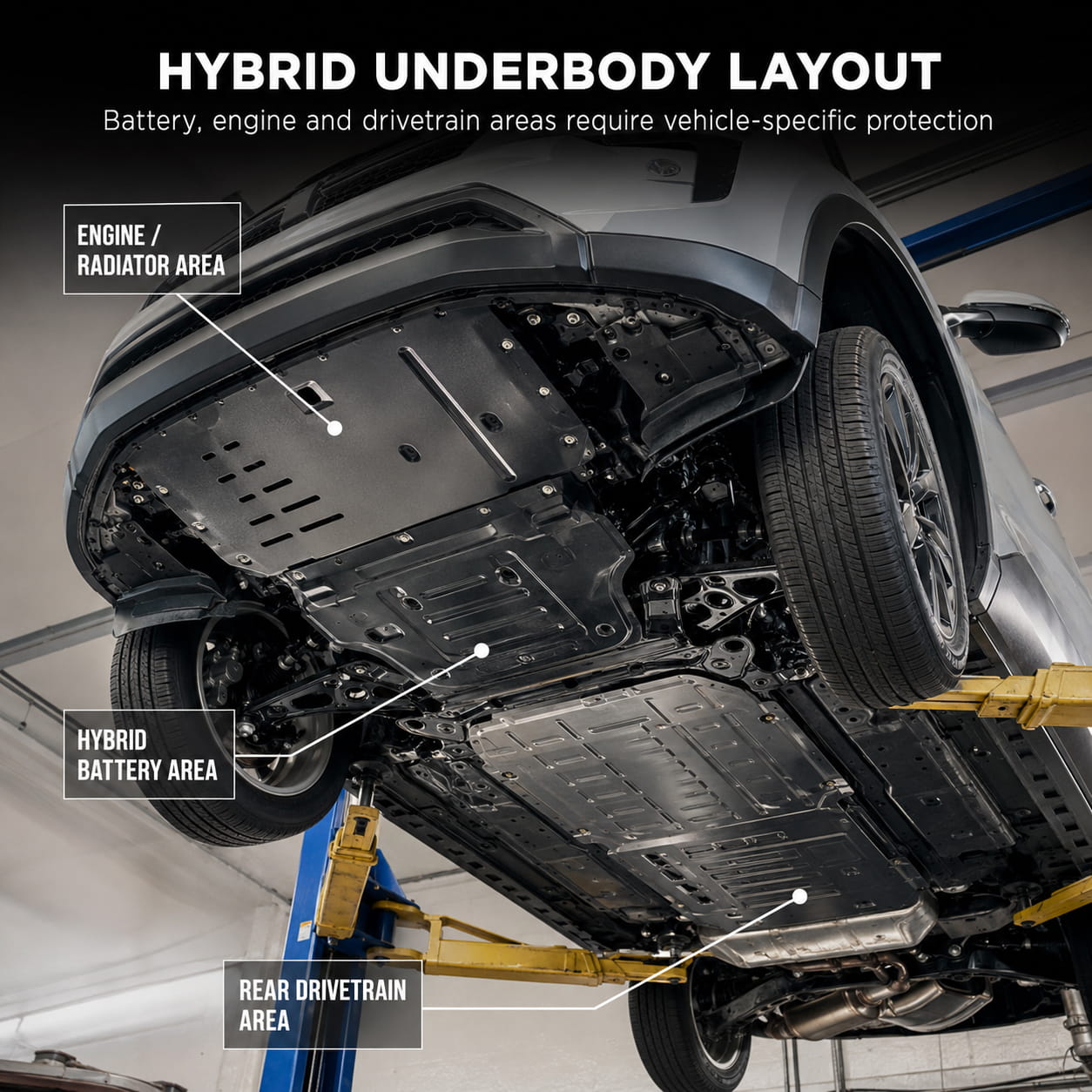
Hybrid vehicles are not always protected in the same way as petrol or diesel vehicles. Even when the exterior body looks similar, the underside of a hybrid version can be different. Battery-related covers, cooling lines, exhaust routing, rear drivetrain components, underbody panels and mounting points may all change.
This is why hybrid skid plates should not be chosen only by model name. The correct protection depends on the exact hybrid layout and on the area that needs protection: engine, radiator, gearbox, battery area, differential or another exposed underbody section.
This guide explains what makes hybrid underbody protection different, which components can be vulnerable and what to check before ordering a skid plate for a hybrid car, SUV or crossover.
Why Hybrid Underbody Protection Is Different
A hybrid vehicle combines a combustion engine with electric drive components. Depending on the model, this can change the underbody layout compared with a petrol or diesel version of the same vehicle.
The difference is not always visible from the outside. Two vehicles may have the same model name, similar body panels and the same production years, but the hybrid version can have different components underneath.
Common hybrid-specific differences may include:
- underfloor battery area or battery-related covers;
- cooling ducts, cooling lines or protective panels;
- different exhaust routing;
- different rear drivetrain or differential layout;
- different factory underbody covers;
- different mounting points for skid plates;
- less free space around protected components;
- different service access requirements.
Because of these differences, a skid plate made for a petrol or diesel version may not fit the hybrid version. It may not align with the mounting points, may not protect the correct area or may interfere with nearby components.
What a Hybrid Skid Plate Can Protect
A hybrid skid plate is not always one large underbody guard. In many cases, hybrid underbody protection means choosing the correct vehicle-specific skid plate for the exposed area.
Depending on the vehicle, protection may be needed for:
- engine lower area and oil pan;
- front lower bumper area;
- radiator or lower cooling area;
- gearbox or transmission area;
- hybrid battery area;
- rear differential or drivetrain components;
- central underbody covers or brackets.
The important point is simple: hybrid protection should follow the real underbody layout of the vehicle, not a generic idea of “full protection”.
Battery Area Protection on Hybrid Vehicles
Some hybrid vehicles have battery-related components positioned underneath the vehicle or close to the lower underbody area. This does not mean every hybrid needs a battery skid plate, but it does mean the battery area should be checked before choosing protection.
A battery skid plate is useful when the battery area or its lower cover is exposed to direct impact from stones, ice blocks, hard snow ridges, gravel, road debris or rough road contact.
A proper battery skid plate should:
- match the exact battery area shape;
- use the correct mounting points;
- avoid contact with the battery housing, covers or cables;
- avoid blocking ventilation, drainage or service access;
- protect the exposed area without creating new interference points.
For example, the Dacia Duster Hybrid 2024–2026 battery skid plate is designed for a specific hybrid vehicle and battery protection area.
Engine and Radiator Protection Still Matter on Hybrids
A hybrid vehicle still has a combustion engine, and in many hybrids the front lower area remains one of the most exposed parts of the vehicle. The oil pan, radiator lower area, gearbox area and lower bumper section can still be vulnerable to road impact.
This is especially relevant when the vehicle has low front clearance or is used on mixed roads, winter roads, rural roads or gravel routes.
On some hybrid cars, the most useful protection is not a battery skid plate, but a front underbody skid plate that covers the engine, radiator, gearbox or front lower bumper area.
For example, the Hyundai i20 Hybrid 2021–2026 engine, front bumper, gearbox and radiator skid plate protects the front lower underbody area of a specific hybrid model.
Differential and Rear Drivetrain Protection on Hybrid SUVs
Some hybrid SUVs and crossovers have rear drivetrain components that can sit low or remain exposed depending on the vehicle design. In these cases, engine protection alone does not protect the rear underbody area.
A rear differential skid plate is designed to protect the differential or rear drivetrain area from impact. This can be relevant for hybrid SUVs used on gravel roads, winter roads, forest roads, rural roads or uneven surfaces.
For example, the Toyota RAV 4 Hybrid 2018–2026 differential skid plate protects the rear differential area on a specific hybrid SUV generation.
For a broader vehicle-specific explanation of when front protection is enough and when rear differential protection becomes relevant, see our Toyota RAV4 underbody protection guide. It explains the differences between front engine, gearbox and radiator protection and separate rear differential protection for compatible AWD and AWD-i configurations.
Why a Non-Hybrid Skid Plate May Not Fit a Hybrid Version
One of the most common mistakes is choosing a skid plate for the standard petrol or diesel model and assuming it will also fit the hybrid version.
That can be wrong for several reasons:
- the hybrid version may have different factory underbody covers;
- the battery area may change the available space;
- mounting holes may be different;
- cooling lines or ducts may be positioned differently;
- exhaust routing may change;
- rear drivetrain layout may differ;
- service openings may be in different places.
A generation-specific example is the Toyota C-HR underbody protection guide. It explains why the 2016–2023 and 2023–2026 applications must be checked separately and how hybrid or plug-in-hybrid configuration can affect engine, gearbox, radiator and catalytic-converter protection.
A wrong skid plate can create practical problems: poor alignment, vibration, blocked service access, contact with nearby components or incomplete protection of the target area.
What to Check Before Buying a Hybrid Skid Plate
Before ordering underbody protection for a hybrid vehicle, check more than just the vehicle model name.
Important details include:
- brand and model;
- production year;
- hybrid version and engine type;
- front-wheel drive, all-wheel drive or 4×4 layout;
- protected area: engine, radiator, gearbox, battery or differential;
- facelift or pre-facelift version;
- body version, if several versions exist;
- factory underbody covers and mounting points.
If one of these details is different, the correct skid plate may also be different.
When Hybrid Underbody Protection Is Most Useful
Hybrid skid plates are most useful when a specific component underneath the vehicle is exposed to real impact risk.
This is often the case when:
- the vehicle has low ground clearance;
- the front lower engine or radiator area is exposed;
- the battery area sits low or has limited factory protection;
- rear drivetrain components are exposed;
- the vehicle is used on gravel, rural or winter roads;
- the vehicle is used for work, travel or mixed road conditions;
- factory plastic covers are not strong enough for the driving conditions.
Hybrid underbody protection is not about adding the largest possible skid plate. It is about protecting the correct vulnerable area without interfering with the hybrid layout.
For a fully electric example of drivetrain-specific protection, see our Tesla Model Y front and rear electric motor skid plate guide, which explains why the front and rear drive units use separate protection zones.
For another electric-vehicle example focused on front underbody protection and material choice, see our Volkswagen ID.4 steel vs aluminium skid plate guide, comparing the available steel and aluminium protection for the front underbody area.
Installation and Safety Considerations
Hybrid vehicles require careful fitment because the underbody can include high-voltage components, battery-related covers, cooling lines and service access areas.
A correctly designed skid plate should not require unsafe modification around hybrid components. It should not block drainage, cooling paths, inspection points or required service access.
Installation should follow the product design and vehicle mounting points. Drilling, cutting or forcing a skid plate into position is not the right approach for hybrid underbody protection.
If the installation area is close to hybrid battery covers, orange high-voltage cables, cooling lines or other sensitive components, installation should be handled carefully by a qualified workshop.
Why VIN Check Is Especially Useful for Hybrid Cars
A VIN check is useful for many vehicles, but it is especially important for hybrids because small differences in production year, drivetrain, body version or hybrid system layout can affect fitment.
A VIN check can help confirm whether the product matches:
- the exact hybrid version;
- the correct production year range;
- the correct drivetrain layout;
- the correct protected component area;
- the correct mounting points.
If you are not sure which skid plate fits your hybrid vehicle, use our Check Compatibility by VIN page before ordering.
So, What Makes Hybrid Skid Plates Different?
Hybrid skid plates are different because hybrid vehicles can have different underbody layouts from petrol and diesel versions. The difference may be around the battery area, radiator, gearbox, rear drivetrain, cooling layout, exhaust routing or mounting points.
The correct skid plate must match the exact vehicle and the exact area that needs protection. For some hybrids, this means engine and radiator protection. For others, it means battery area protection, differential protection or a combination of several vehicle-specific skid plates.
For hybrid vehicles, the safest approach is to choose protection by exact fitment, protected component area and VIN compatibility — not by universal size or model name alone.
Find Hybrid Skid Plates for Your Vehicle
At UnderbodyGuards, we supply vehicle-specific underbody protection for European cars, SUVs, vans, pickups and hybrids.
You can browse available skid plates by vehicle brand, model and year here: Shop by Vehicle
If you are not sure which hybrid skid plate fits your vehicle, send us your VIN and we will help confirm compatibility before you order: Check Compatibility by VIN
FAQ
Are hybrid skid plates different from standard skid plates?
Yes. A hybrid skid plate may need to account for battery-related components, cooling lines, different exhaust routing, rear drivetrain parts and hybrid-specific underbody covers. This is why a skid plate for a petrol or diesel version may not automatically fit the hybrid version.
Can I use a petrol or diesel skid plate on a hybrid car?
Only if the product is confirmed to fit the hybrid version. Even when the exterior body looks the same, the hybrid underbody can have different mounting points, component positions or clearance around the protected area.
Which parts of a hybrid vehicle can be protected?
Depending on the model, underbody protection can cover the engine, oil pan, gearbox, radiator area, front lower bumper area, hybrid battery area, rear differential or other exposed drivetrain components.
Do all hybrid cars need battery skid plates?
No. Some hybrid vehicles mainly need engine, gearbox or radiator protection. A battery skid plate is useful only when the battery area or its lower cover is exposed to stones, ice, gravel, road debris or rough road impact.
Why is VIN compatibility important for hybrid skid plates?
A VIN check helps confirm the exact hybrid version, production year, drivetrain layout and factory underbody configuration. This is important because small differences can affect whether the skid plate fits correctly.
Is universal underbody protection suitable for hybrid cars?
Usually not. Universal skid plates may require modification, may not protect the correct component area and may interfere with hybrid-specific parts. Vehicle-specific skid plates are a safer and more precise choice for hybrid vehicles.
