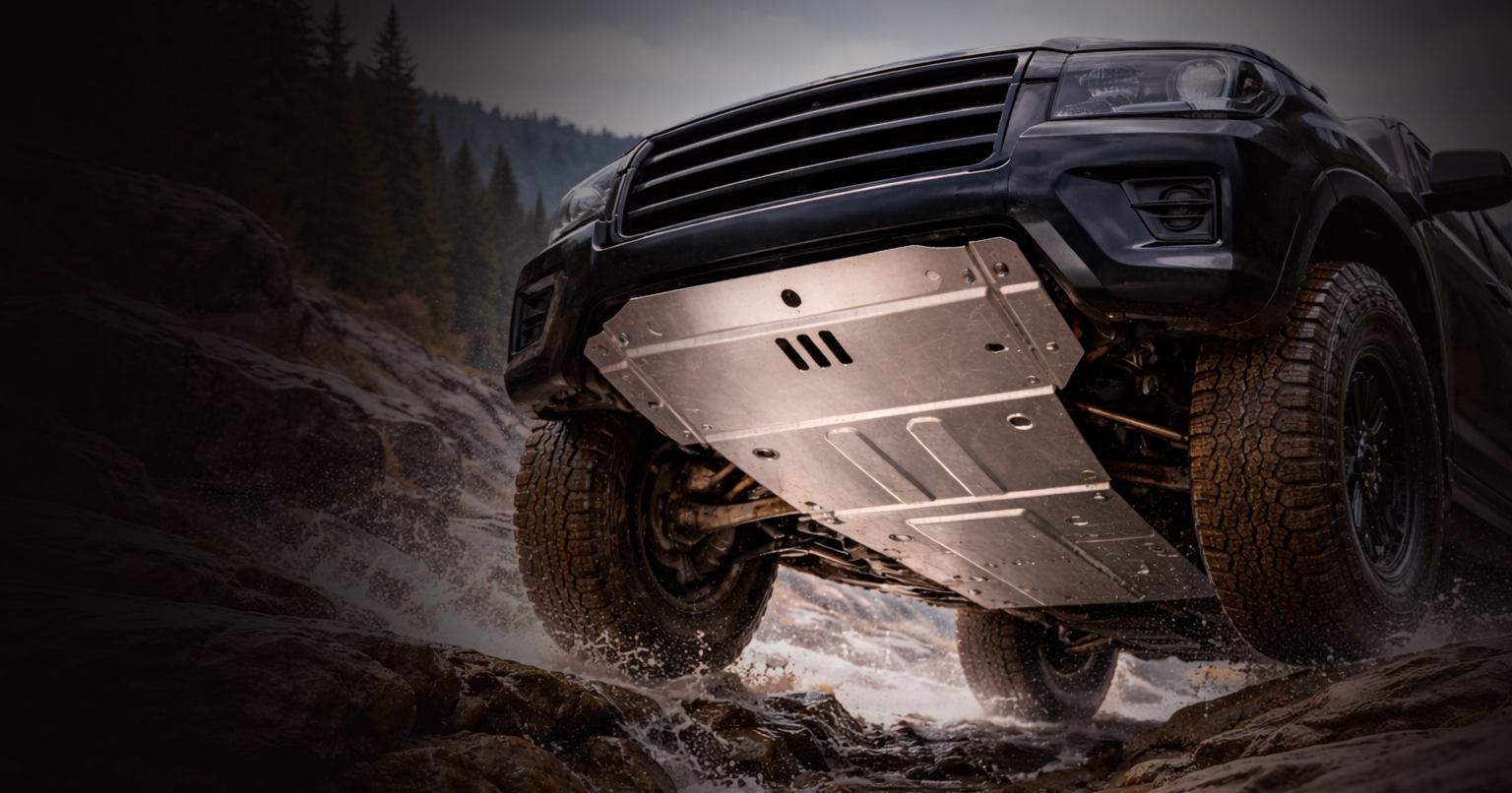
Mercedes Sprinter Underbody Protection Guide: What to Protect by Generation and Drivetrain
Quick answer: The first protection priority on most Mercedes Sprinter vans is the engine and lower front area. The next priority depends on the exact generation and drivetrain: some applications also require protection for the gearbox, radiator area, front bumper area or electric power steering gear. A skid plate listed for a front-wheel-drive Sprinter must not be assumed to fit a rear-wheel-drive or 4Г—4/AWD vehicle, even when the model year is the same.
The Mercedes Sprinter has been produced in several generations and in many commercial configurations, including panel vans, chassis cabs, minibuses, camper conversions and specialist work vehicles. Wheelbase, gross vehicle weight, engine, transmission, drivetrain and conversion equipment can all affect the underbody layout. This makes a vehicle-specific fitment check more important than simply searching for a plate by model name.
Important fitment note: The year ranges shown in this guide reflect individual product listings and do not mean that one plate fits every Sprinter produced within those years. Confirm the exact VIN, model year, engine, drivetrain, body configuration, underbody layout and mounting points before ordering. Do not assume that a protection plate listed for a combustion-engine Sprinter is suitable for an eSprinter unless the product listing expressly confirms it.
Why Mercedes Sprinter Underbody Protection Requires a Precise Fitment Check
A Sprinter used for local deliveries faces different risks from a camper travelling on gravel roads or a service van entering construction sites. The vehicle may also carry permanent conversion weight, water tanks, steps, tow equipment or other accessories that change ground clearance and access underneath the van.
More importantly, the protected components are not positioned identically on every Sprinter. The first Sprinter production period began in 1995, a second generation arrived in 2006, and the current generation followed in 2018. Within these broad periods, drivetrain and market-specific differences still matter. A plate should therefore be selected for the exact vehicle application rather than for the generation alone.
| Sprinter production period | Typical first priority | Main fitment caution |
|---|---|---|
| 1995–2006 | Engine and lower powertrain area | Check engine, chassis, mounting points and previous modifications |
| 2006–2018 | Engine, then gearbox where the listed plate provides coverage | Standard drivetrain and 4×4 applications may require different protection |
| 2018–2026 | Engine and lower front area, followed by drivetrain-specific components | FWD, RWD and 4×4/AWD layouts are not interchangeable; eSprinter requires separate confirmation |
What Should Be Protected First on a Mercedes Sprinter?
1. Engine and Lower Powertrain Area
The engine area is normally the first protection priority because it sits near the front of the vehicle and may be exposed to broken road surfaces, compacted snow, loose stones, raised tracks, worksite debris and contact with uneven ground. The original plastic undertray, where fitted, may help with airflow, splash control and dirt, but it is not automatically a structural impact guard.
A vehicle-specific metal skid plate creates a stronger barrier below the listed components. Its performance depends on more than the material name: plate thickness, grade, shape, reinforcement, load distribution and mounting design all matter. The guard must use the correct mounting points and must not transfer loads into unsuitable panels, hoses or cooling components.
2. Radiator and Lower Front Area
On applications where the radiator or lower front area is exposed, protection may reduce the risk from stones, frozen road debris and uneven approaches. Coverage must be designed for the specific vehicle. A guard should protect the lower front area without blocking the airflow required for engine, transmission or other vehicle cooling systems.
The words “engine skid plate” do not automatically mean that the radiator and front bumper area are also covered. Check the protected-components list on the product page and compare it with the actual underside of the van.
3. Gearbox and Transmission Area
Gearbox protection becomes more important on work vans, campers and vehicles that regularly use rutted tracks or roads with high centre sections. Some Sprinter products combine engine and gearbox coverage, while others protect the engine and lower front area only. Do not infer gearbox coverage from the overall size of the plate.
A combined guard can create broader longitudinal protection, but the correct design depends on the drivetrain and transmission layout. Service access, ventilation, exhaust clearance and movement of the powertrain must remain adequate after installation.
4. Electric Power Steering Gear on Listed Newer 4Г—4 Applications
Selected newer Sprinter 4Г—4 applications have dedicated protection options for the electric power steering gear and gearbox area. This is a configuration-specific product type, not a universal requirement for every Sprinter. Before ordering, confirm that the protected components, model-year range and mounting pattern match the exact vehicle.
Mercedes Sprinter Underbody Protection by Generation
Sprinter 1995–2006: Start with the Engine Area
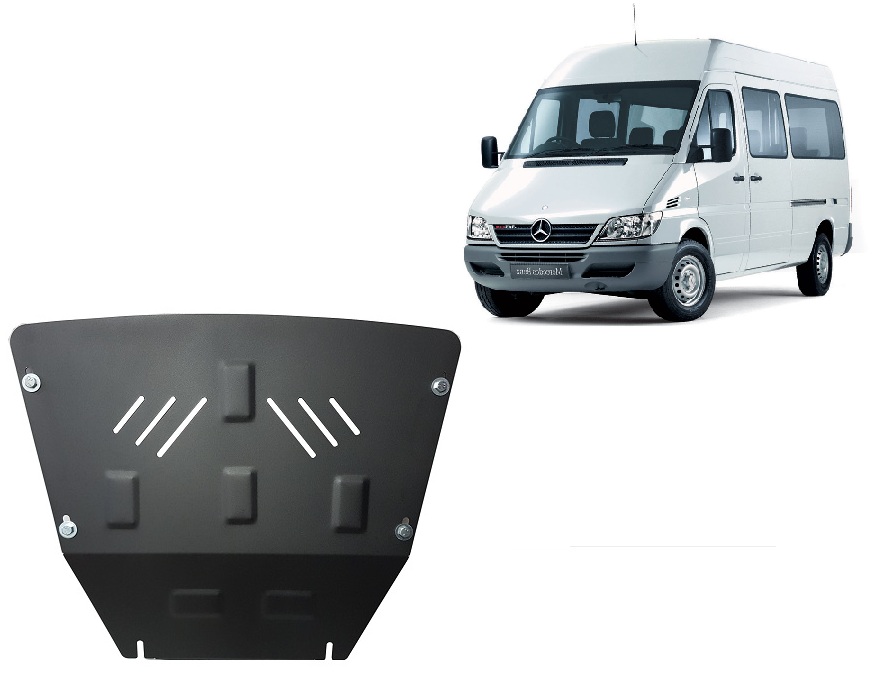
For listed 1995–2006 vehicles, the most direct upgrade is usually an engine skid plate. The available 2.5 mm steel Mercedes Sprinter engine skid plate is an example of generation-specific front protection. It should still be checked against the exact engine, chassis, mounting points and any modifications made during the van’s service life.
Older commercial vans may have repaired crossmembers, replaced undertrays, corrosion, conversion hardware or non-standard accessories. Inspect the underside before purchase and again before installation.
Sprinter 2006–2018: Separate Standard and 4×4 Applications
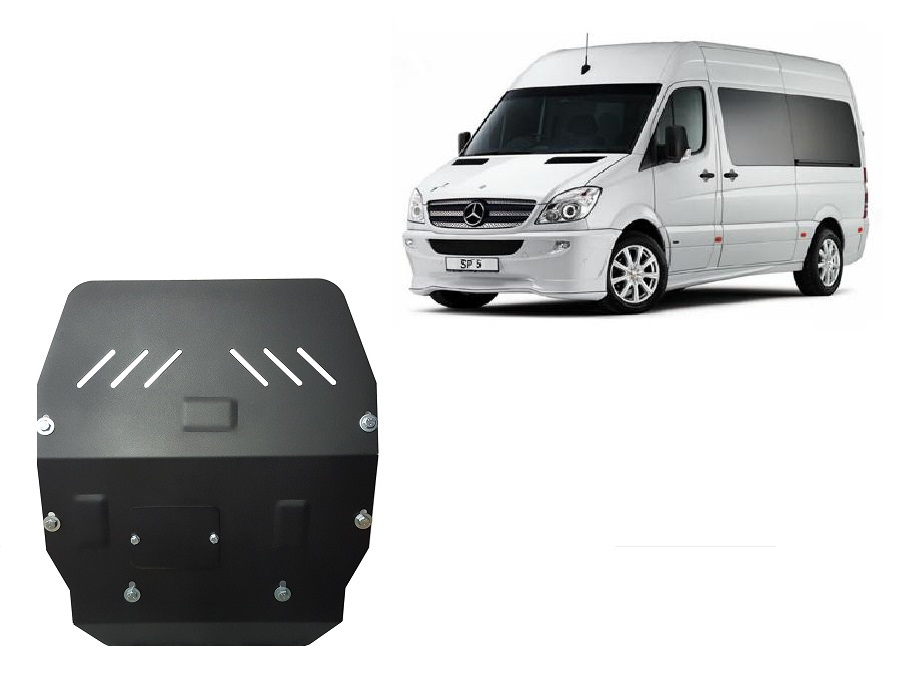
For the second Sprinter generation, protection may cover the engine alone or combine the engine and gearbox. The 3 mm steel engine and gearbox skid plate for listed 2006–2017 vehicles provides broader coverage than an engine-only plate.
Four-wheel-drive versions must be treated separately. The Sprinter 906 4×4 engine skid plate for listed 2006–2017 applications is identified specifically for that drivetrain. A 4×4 designation should not be added or removed based only on visual similarity.
There is also an aluminium engine and gearbox option for selected 2006–2018 Sprinter applications. The slightly different year range is another reason to follow the individual product listing rather than treating every generation range as universal fitment.
Sprinter 2018–2026: FWD, RWD and 4×4/AWD Must Be Matched Separately
The current Sprinter generation has the greatest fitment risk because several drivetrain layouts exist across markets and model years. A front-wheel-drive guard, rear-wheel-drive guard and 4Г—4/AWD guard may protect different components and use different mounting geometry.
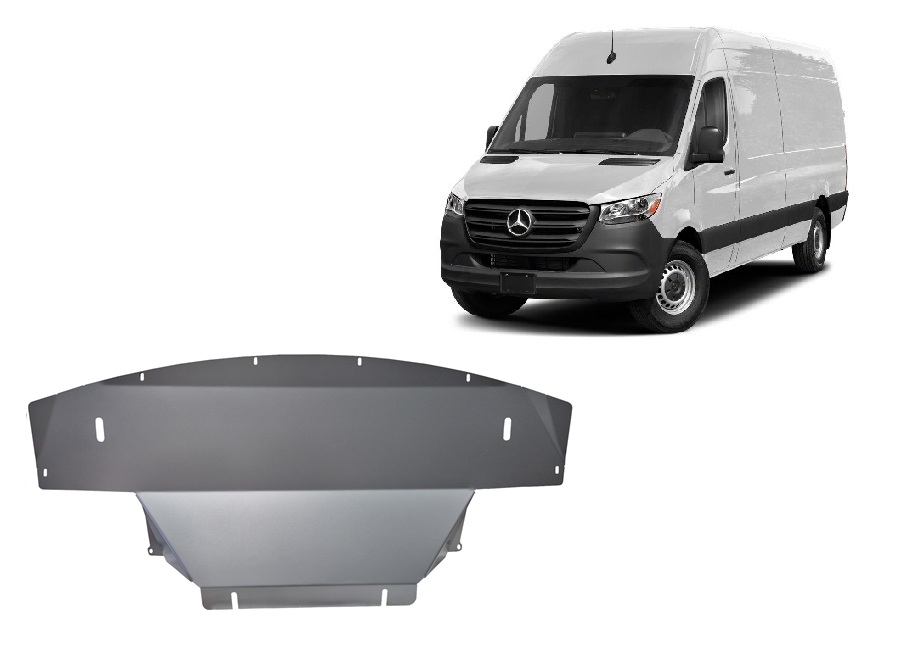
- FWD: the listed 2018–2026 FWD steel skid plate covers the engine, front bumper, gearbox and radiator areas for the specified applications.
- RWD: the listed 2018–2026 RWD steel skid plate covers the engine, front bumper and radiator areas for the specified applications.
- 4×4, 2018–2023 listing: the Sprinter 907 4×4 steel skid plate is listed for engine, front bumper, gearbox and radiator protection.
- 4×4, 2024–2026 listing: a separate 2024–2026 Sprinter 907 4×4 steel skid plate is available for the later listed fitment range.
The split between the 2018–2023 and 2024–2026 4×4 product listings is important. Do not extend either product beyond its stated application without a compatibility check. Drivetrain terminology can also vary by market and model year, so use the VIN and the vehicle’s technical data rather than relying only on a badge.
FWD vs RWD vs 4Г—4/AWD: Why the Same Plate Does Not Fit Every Sprinter
| Drivetrain | What changes underneath | Selection rule |
|---|---|---|
| FWD | Powertrain packaging and front underbody geometry differ from RWD versions | Use only a product listing that expressly includes FWD |
| RWD | Transmission and driveline layout follow a different path beneath the vehicle | Do not substitute an FWD or 4Г—4 guard |
| 4Г—4/AWD | Additional drivetrain components and different mounting geometry may affect coverage | Match the exact product range, vehicle data and VIN |
| eSprinter | High-voltage battery and electric-drive architecture differ fundamentally from combustion-engine versions | Use only protection explicitly approved for the exact eSprinter application |
Steel or Aluminium for a Mercedes Sprinter?
Material should be chosen together with the plate design and the way the van is used. Steel is often preferred where repeated or harder impacts are expected. Aluminium reduces weight and offers strong resistance to conventional red-rust corrosion, although fasteners and contact points still require correct protection and installation.
| Factor | Steel skid plate | Aluminium skid plate |
|---|---|---|
| Typical reason to choose it | Repeated rough-road, worksite or harder-impact exposure | Lower added weight and high resistance to red-rust corrosion |
| Weight | Usually heavier for comparable coverage | Usually lighter |
| Corrosion consideration | Coating damage should be inspected and repaired | Does not form conventional red rust, but oxidation and galvanic contact still require attention |
| What determines real performance | Thickness, material grade, shape, reinforcement, mounting design, coverage and installed clearance | |
For a detailed material comparison, read Steel vs Aluminium Skid Plates: Which Material Is Right for You?
Choose Protection According to How the Sprinter Is Used
Urban Delivery and Fleet Vans
Urban vans regularly encounter kerbs, ramps, road repairs, speed bumps and loose debris. Engine and lower front protection is usually the first priority. Fleet operators should also consider ease of inspection, service access, vehicle downtime and the added weight of the selected guard.
Construction, Utility and Service Vehicles
Vehicles entering worksites or unpaved access roads face deeper ruts, sharp debris and high centre sections. Broader protection extending from the engine toward the gearbox may be justified when a compatible product exists. A plate should not be used as a substitute for sufficient ground clearance or careful route selection.
Camper Vans and Overland Conversions
Camper conversions often operate at higher permanent weight and may have tanks, heaters, steps or conversion hardware fitted underneath. Protection decisions should be made after the completed conversion is inspected. Confirm that the skid plate does not interfere with conversion equipment, drainage, exhaust routing, jacking points or scheduled maintenance.
Installation, Cooling and Vehicle Service
A correctly designed skid plate should attach to the specified structural mounting points and maintain safe clearance from moving, hot and flexible components. Installation should never force the plate into place or rely on improvised holes where the manufacturer has not specified them.
- Confirm that all supplied brackets and fasteners match the installation guide.
- Check clearance around the engine, gearbox, steering gear, exhaust and cooling components.
- Make sure ventilation openings are not blocked.
- Verify whether the plate must be removed for oil changes or other service operations.
- Recheck fastener torque after the initial driving period and inspect the guard after any significant impact.
- Repair damaged steel coating and inspect aluminium contact points and fasteners for corrosion.
Read Will a Skid Plate Affect Cooling, Noise or Vehicle Service? for a more detailed explanation of installation-related considerations.
How to Select the Correct Mercedes Sprinter Skid Plate
- Record the VIN. It is the most reliable starting point for identifying the exact vehicle.
- Confirm the production year and generation. Do not rely on the registration year alone when a vehicle may have been built earlier.
- Identify the drivetrain. Confirm whether the van is FWD, RWD or a listed 4Г—4/AWD configuration.
- Confirm the engine and transmission. “All engine variants” on a listing does not remove the need to verify the vehicle.
- Check body and weight configuration. Wheelbase, chassis type and conversion equipment may affect access and clearance.
- Compare the protected zones. Engine-only, engine-and-gearbox and broader front-area guards are different products.
- Inspect the mounting points. Previous repairs, corrosion or conversion work may change the installation conditions.
- Confirm eSprinter separately. Never transfer fitment from a diesel or petrol listing to an electric vehicle without explicit approval.
If any part of the configuration is uncertain, use our guide to finding skid plates by VIN and send the VIN before purchase.
Available Mercedes Sprinter Protection Options
The Mercedes Sprinter underbody protection category includes vehicle-specific steel and aluminium options for selected applications. Examples include engine protection for early Sprinter vans, combined engine and gearbox protection for selected second-generation vehicles, and separate FWD, RWD and 4Г—4 products for the current generation.
These products illustrate different coverage and material choices; they do not apply universally to every Sprinter in the stated year ranges. Compare the exact product title, protected components, drivetrain, installation guide and fitment data before ordering.
Frequently Asked Questions
Does every Mercedes Sprinter use the same skid plate?
No. Generation, drivetrain, engine, transmission, body configuration, market specification and mounting points can change the required plate. FWD, RWD and 4Г—4/AWD products must not be treated as interchangeable.
What should I protect first on a Mercedes Sprinter?
The engine and lower front area are normally the first priority. Gearbox, radiator, front bumper area and steering-gear protection may follow where the exact vehicle and product listing support those zones.
Is the original plastic undertray enough?
A plastic undertray can help manage airflow, water and dirt, but it should not automatically be treated as structural impact protection. The required level of protection depends on the vehicle’s use and the design of the original part.
Is steel always stronger than aluminium?
Not as a universal rule. Actual performance depends on thickness, material grade, reinforcement, geometry and mounting design. Steel is often chosen for repeated or harder-impact exposure, while aluminium is useful where lower added weight and resistance to conventional red-rust corrosion are priorities.
Can a skid plate affect cooling or servicing?
An incorrectly designed or installed plate can obstruct airflow, create contact or complicate service access. Use a vehicle-specific product, follow the installation guide and confirm cooling clearance and maintenance requirements after fitting.
Can I choose a Sprinter skid plate by model year alone?
No. Model year is only one part of the fitment check. You must also verify the VIN, drivetrain, engine, transmission, body configuration, underbody layout and mounting points.
Will these skid plates fit an eSprinter?
Do not assume so. The eSprinter has a different electric-drive and high-voltage battery layout. Use only a product listing that explicitly confirms compatibility with the exact eSprinter model and configuration.
Final Recommendation
Choose Mercedes Sprinter underbody protection in this order: identify the exact vehicle, confirm the drivetrain, decide which components are genuinely exposed, and then compare compatible steel or aluminium products. For most vans, engine and lower front protection comes first; broader gearbox or drivetrain-specific coverage should be added only where the product listing and actual underbody layout confirm fitment.
Browse Mercedes Sprinter skid plates and underbody protection. If you are unsure which option fits, send us the VIN and vehicle details before ordering.
