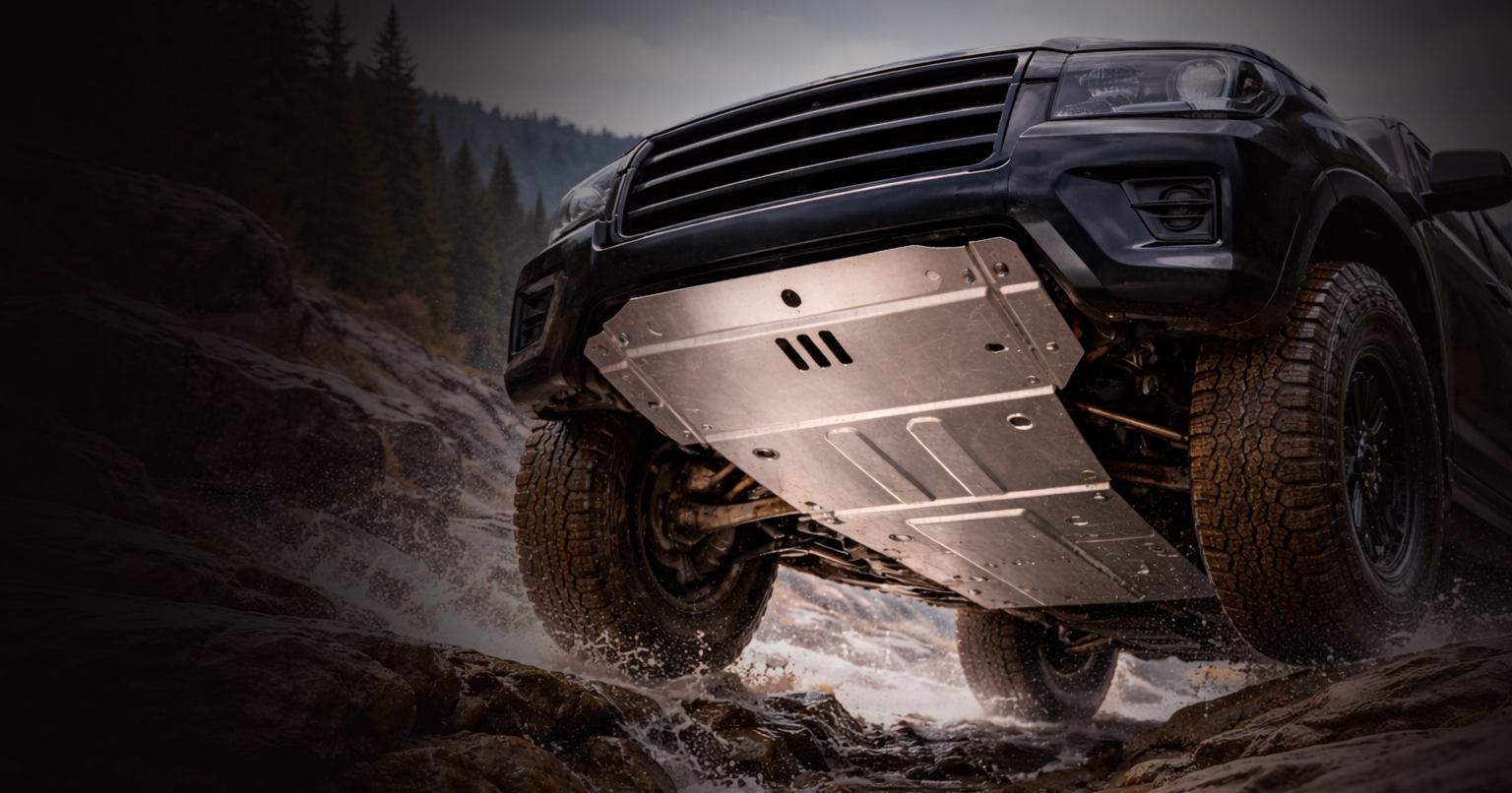
Toyota Hilux Underbody Protection Guide by Generation (2000–2026)
The Toyota Hilux is used on worksites, farms, forestry roads, gravel tracks and off-road routes where exposed underbody components can be struck by stones, compacted soil, deep ruts and raised ground. However, the protection layout is not the same across every Hilux generation.
This guide compares the main Toyota Hilux underbody protection options listed for vehicles from 2000 to 2026. It explains which areas can be protected, how the available configurations change by model year and why the exact generation, drivetrain and underbody layout must be checked before ordering.
Available applications include protection for the engine, radiator, front bumper area, gearbox, differential, transfer case, particle filter, particle-filter sensor and fuel tank. Start by identifying the correct Hilux generation, then choose the protection zones that match the vehicle and its real driving conditions.
Toyota Hilux generations covered
The UnderbodyGuards catalogue currently separates Toyota Hilux protection into three main product groups:
- Toyota Hilux 2000–2015 underbody protection
- Toyota Hilux Revo 2016–2026 underbody protection
- Toyota Hilux Invincible 2021–2026 underbody protection
Names such as Vigo, Revo, N70 and N80 can be used differently between markets, production periods and body configurations. Do not rely on a regional nickname alone. Confirm the model year, VIN, engine, transmission, drivetrain and existing underbody layout before selecting a skid plate.
Toyota Hilux 2000–2004
For Toyota Hilux models listed from 2000 to 2004, the catalogue includes separate protection for the engine, differential and gearbox, as well as the fuel tank. This allows the vehicle owner to build protection according to the components that are most exposed on the specific vehicle.
An engine plate is normally the first priority because the lower engine area can be contacted by rocks, frozen ruts and raised ground before obstacles reach the centre of the vehicle. The listed Toyota Hilux 2000–2004 engine skid plate is made from 3 mm steel.
Vehicles used on deeply rutted tracks may also benefit from gearbox and differential protection. Fuel-tank protection is particularly relevant where long objects, sharp stones or uneven terrain can reach the rear section of the underside.
Toyota Hilux 2004–2015
The 2004–2015 product group offers broader combinations. Listed applications include the engine, front bumper area and radiator, together with separate centre-underbody and fuel-tank options.
For drivers who want broad front coverage, the Toyota Hilux 2004–2015 engine, front bumper and radiator skid plate combines several vulnerable front zones in one listed application. Other configurations separate the engine and radiator areas, allowing protection to be matched more precisely to the vehicle.
Further rearward, the catalogue includes plates for the differential, gearbox and particle-filter area. These components can remain exposed after the front axle has already crossed an obstacle, especially when a rock or raised centre section passes between the wheel tracks.
Toyota Hilux Revo 2016–2026
The Hilux Revo range has the widest selection of material and protection-zone combinations. Depending on the exact application, listed plates protect the engine, radiator, gearbox, differential, transfer case, particle filter and fuel tank.
Separate engine plates are available in 3 mm steel and 4 mm aluminium. Gearbox protection is also listed in 3 mm steel and 4 mm aluminium.
This modular approach is useful because not every Hilux needs the same coverage. A road-driven pickup may prioritise the engine and radiator, while a vehicle used on forestry tracks or construction routes may require additional gearbox, transfer-case, differential and fuel-tank protection.
Toyota Hilux Invincible 2021–2026
The Hilux Invincible product group is listed separately for 2021–2026 configurations. Available protection includes the engine, radiator, gearbox, differential, transfer case, particle filter, particle-filter sensor and fuel tank.
For centre-drivetrain coverage, the catalogue includes a 3 mm steel differential, particle-filter and transfer-case plate and a 4 mm aluminium differential and transfer-case plate. The protected areas are not identical, so the product description must be checked carefully rather than choosing by material alone.
A separate particle-filter sensor guard is also listed for compatible 2021–2026 vehicles. This is a configuration-specific protection zone and should only be selected after confirming that the vehicle has the corresponding component and mounting layout.
Which Toyota Hilux parts should be protected first?
1. Engine and oil-sump area
The engine area is usually the first priority. It is positioned near the front of the vehicle and may be exposed to rocks, debris, frozen snow and direct contact with uneven ground. An engine skid plate creates a barrier below this area, although exact oil-sump coverage and service access depend on the individual plate design.
2. Radiator and lower front area
The lower cooling area can be reached by objects approaching from beneath the front of the pickup. Radiator protection is especially relevant on rough tracks, damaged roads and routes with compacted snow or loose stones. Engine and radiator protection should be treated as separate zones unless the chosen product explicitly covers both.
3. Gearbox
The gearbox sits farther back than the engine and can remain exposed when the front axle has already climbed over an obstacle. A centre ridge or rock between the wheel tracks may contact this area. Read our gearbox skid plate guide for a more detailed explanation of transmission protection.
4. Differential and transfer case
On compatible four-wheel-drive configurations, the differential and transfer case are important drivetrain components. Their position makes them relevant protection priorities for vehicles regularly crossing rocks, deep ruts and uneven terrain. Always confirm which components are actually covered by the selected plate.
5. Fuel tank
Fuel-tank protection becomes more important when the vehicle is used on rocky routes, agricultural land, forestry roads or worksites where long or sharp objects may reach the rear underside. Learn more in our fuel tank skid plate guide.
6. Particle filter and sensor
Some later Hilux applications include protection for the particle filter or its sensor. These are configuration-dependent areas. The model year alone may not confirm compatibility, so the exhaust and emissions layout must be checked before installation.
Engine-only protection or a complete system?
An engine plate protects only the area stated in its product description. It does not automatically cover the radiator, gearbox, differential, transfer case or fuel tank. A more complete system uses several compatible plates to extend coverage from the front towards the centre and rear underside.
The correct choice depends on where the Hilux is driven:
- Normal roads and occasional gravel: engine protection is normally the starting point; radiator coverage may also be relevant.
- Winter roads and damaged surfaces: consider the engine, lower radiator area and other components exposed to hidden impacts.
- Forestry, agricultural and construction routes: add gearbox, drivetrain and fuel-tank protection according to the vehicle layout.
- Frequent rocky off-road driving: broader multi-zone protection provides a more continuous barrier beneath the vehicle.
For a broader comparison, read our engine skid plate vs full underbody protection guide.
Steel or aluminium for the Toyota Hilux?
Steel and aluminium should be compared as complete plate systems, not by thickness alone. Plate geometry, reinforcement, mounting design, coverage and material grade all influence actual performance.
- Steel: commonly selected when resistance to repeated concentrated impacts is the main priority. It is normally heavier and its protective coating should be inspected after impacts or winter use.
- Aluminium: naturally resistant to rust and often chosen when corrosion behaviour and lower system weight are important. Actual weight depends on the individual plate and design.
Do not assume that every aluminium option is lighter than every steel option. Compare the listed weight, protected zones and mounting system for the exact products. Our steel vs aluminium skid plate guide explains the main differences in more detail.
Fitment and installation checks
Before ordering Toyota Hilux underbody protection, confirm:
- complete VIN;
- model year and production period;
- regional model or trim name;
- engine and transmission;
- two-wheel-drive or four-wheel-drive configuration;
- body and wheelbase version where relevant;
- emissions and particle-filter layout;
- existing factory or aftermarket underbody components;
- mounting-point layout and required service access.
Installation should follow the product-specific manual and fastening sequence. Verify clearance around the exhaust, cooling system, suspension and moving drivetrain components. If the owner does not have the necessary tools or experience, professional installation is recommended.
Maintenance after installation
After winter or off-road driving, remove accumulated mud, stones, packed snow and road salt. Inspect the plates, brackets, fasteners and mounting points. Following a significant impact, check for deformation, loosened hardware, reduced clearance or contact with surrounding components.
Damaged protective coating on a steel plate should be cleaned and treated as required. Aluminium does not rust like steel, but the complete installation, brackets and fasteners still require periodic inspection.
FAQ
Which Toyota Hilux generations are covered in this guide?
The listed catalogue applications cover Toyota Hilux models from 2000–2004, 2004–2015, Hilux Revo from 2016–2026 and Hilux Invincible from 2021–2026. Exact availability depends on the vehicle configuration.
Are Hilux Vigo, Revo, N70 and N80 names interchangeable?
No. These names and chassis references can vary by market and production period. Use the VIN, model year and exact vehicle configuration rather than relying only on a regional nickname.
Does an engine skid plate protect the radiator and gearbox?
Only when those areas are explicitly included in the product description. Engine, radiator and gearbox protection are separate zones on many Hilux applications.
Which skid plate should be installed first?
Engine protection is usually the first priority. Radiator protection is often the next front-area consideration, followed by gearbox, drivetrain and fuel-tank protection according to the vehicle layout and driving conditions.
Is steel or aluminium better for a Toyota Hilux?
Choose according to the expected impacts, corrosion exposure, total plate weight, coverage and maintenance requirements. Steel is commonly selected for repeated concentrated impacts, while aluminium is attractive where corrosion resistance and lower added weight are priorities.
Can several Hilux skid plates be installed together?
Compatible plates can form a broader multi-zone system, but they must be listed for the same vehicle configuration and designed to work with the relevant mounting points. Confirm compatibility before combining individual sections.
Do I need to check the VIN before ordering?
Yes. The VIN, model year, drivetrain, engine, transmission and underbody layout should be checked because Toyota Hilux configurations vary between generations and markets.
