Toyota Land Cruiser 250 Skid Plates: Complete Protection Guide
The Toyota Land Cruiser 250 is designed for difficult terrain, but serious off-road ability does not make every component underneath the vehicle immune to impact. A rock, frozen rut, broken road edge or raised centre section can still reach the cooling system, engine area or drivetrain before a tyre climbs over the obstacle.
The useful question is therefore not simply whether an LC250 needs a skid plate. It is which areas should be protected first, which material matches the vehicle’s real use, and whether a partial or complete protection system makes more sense.
This guide explains the protection priorities for the Toyota Land Cruiser 250, also known in some markets as the Land Cruiser Prado 250. It covers the radiator, engine, front differential, gearbox and transfer case, then compares 3 mm steel with 4 mm aluminium options available for 2024–2026 vehicles.
Why the Land Cruiser 250 Still Benefits from Underbody Protection
The LC250’s off-road capability and the protection of individual underbody components are different engineering questions. An exposed casing, cooling component or low point beneath the drivetrain can still suffer a direct localised strike.
Risk increases when the vehicle is used on:
- rocky tracks and deep ruts;
- forestry, agricultural or construction-site roads;
- snow-covered roads where obstacles are difficult to see;
- gravel roads with loose stones and washouts;
- overland routes with additional cargo;
- steep crests and raised centre sections between the wheel tracks.
Underbody protection should be treated as a system of priorities. The correct setup depends on where the LC250 is driven, which component is most exposed in those conditions and how much additional weight the owner is prepared to add.
What Should You Protect on a Toyota Land Cruiser 250?
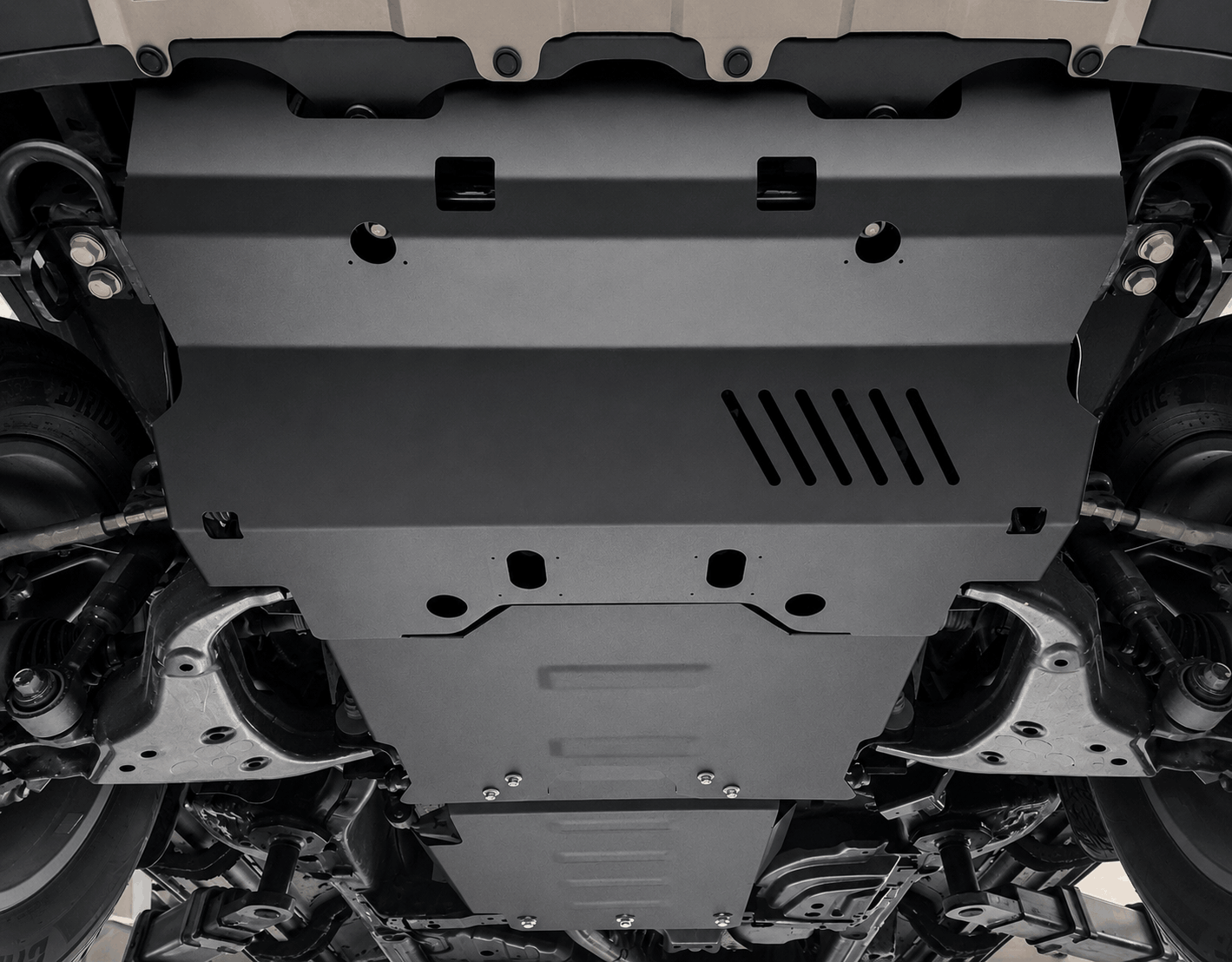
For the LC250, the main protection chain runs from the lower front of the vehicle towards the centre of the drivetrain:
- Radiator and lower front area
- Engine underside and, depending on the selected plate, the front differential area
- Gearbox
- Transfer case
These zones face different types of contact. The front sections are more exposed to direct approach impacts and debris, while the gearbox and transfer case become especially relevant when the vehicle passes over a ridge, rock or raised centre section between the axles.
1. Radiator Protection
The radiator and lower cooling area sit at the front of the protection chain. They can be exposed when the vehicle approaches a rock, compacted snowbank, branch or abrupt road edge. Damage in this area is not only a question of a bent panel: coolant loss can quickly turn a manageable impact into an overheating problem.
A radiator skid plate is therefore a logical first layer for vehicles that regularly travel on loose gravel, forest roads, snow-covered routes or uneven access roads. It is also relevant to owners who do not intend to drive technically difficult trails but want better protection against unseen frontal hazards.
Available LC250 options include a 3 mm steel radiator skid plate and a 4 mm aluminium radiator skid plate.
2. Engine and Front Differential Protection
The engine underside is normally the highest priority because an impact in the sump area can lead to deformation, cracking or oil loss. Continuing to run an engine after substantial oil loss can turn a single underbody strike into a major mechanical failure.
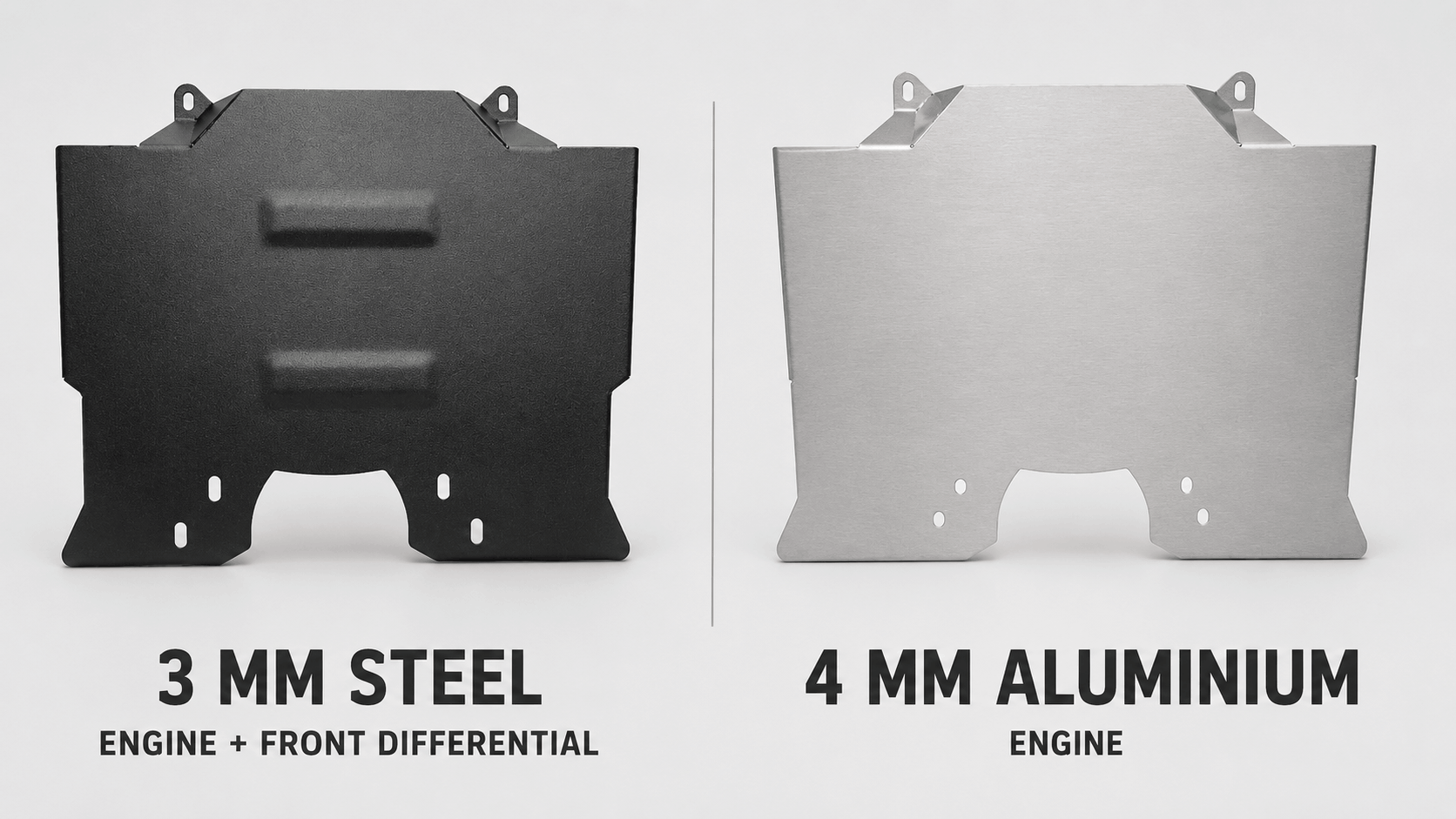
The front differential is also part of the LC250’s four-wheel-drive system and is positioned in a zone that can meet rocks or hard terrain near the front axle. A plate that covers both the engine and front differential provides broader protection than an engine-only shield, but the exact coverage must always be checked on the individual product page.
UnderbodyGuards offers two different front-section choices:
- 3 mm steel engine and front differential skid plate — the broader steel option for this area;
- 4 mm aluminium engine skid plate — a corrosion-resistant aluminium option whose listed coverage is the engine area.
This distinction matters. Material thickness alone does not tell you which components are covered. Always compare the stated protection zones as well as the material.
3. Gearbox Protection
The gearbox is located farther back than the engine, so it is less likely to take the first frontal impact. Its risk increases when the vehicle straddles an obstacle or crosses a raised centre section. At that point, the front wheels may already have cleared the obstacle while the centre of the vehicle moves directly over it.
A direct strike can affect the transmission casing, surrounding components or mounting area. Gearbox protection is therefore a high priority for vehicles used on deep ruts, rocky tracks and uneven terrain, even if the front engine area is already protected.
4. Transfer-Case Protection
The transfer case distributes drive through the four-wheel-drive system. It is a critical drivetrain component, and damage can result in fluid loss, loss of drive or an immobilised vehicle. The consequences become more serious when the impact occurs far from a paved road or workshop.
For this reason, LC250 protection for the central drivetrain is offered as a combined gearbox and transfer-case plate rather than treating the two components as unrelated zones:
- 3 mm steel gearbox and transfer-case skid plate;
- 4 mm aluminium gearbox and transfer-case skid plate.
For a detailed comparison of centre-drivetrain protection, see our Toyota Land Cruiser 250 gearbox and transfer case protection guide. It compares the 3 mm steel and 4 mm aluminium versions, explains why both are listed at 10 kg, and shows when centre-underbody protection becomes important on ruts, rocky tracks and raised terrain.
Which LC250 Skid Plate Should You Install First?
If the budget or intended use does not justify a complete system immediately, use this order of priority:
- Engine protection first. The engine underside contains the most immediately critical lubrication-related risk.
- Add radiator protection. This strengthens the forward protection chain against frontal obstacles and debris.
- Add gearbox and transfer-case protection. This is essential once the vehicle regularly crosses deep ruts, rocks or raised terrain between the axles.
For frequent off-road or overland use, installing separate plates in stages may ultimately cost more time than choosing a matched complete system. A continuous protection chain also avoids leaving a vulnerable gap between well-protected areas.
Partial Protection or a Complete Skid Plate Set?
Daily Driving, Winter Roads and Occasional Gravel
For an LC250 used mainly on paved roads, winter routes and maintained gravel roads, the engine area is the sensible starting point. Radiator protection becomes more valuable when loose stones, snow-covered road edges or poorly maintained rural access roads are common.
In this use case, a partial system can be rational. The objective is not to build maximum trail armour but to protect the areas most likely to convert a road hazard into an immediate mechanical problem.
Forestry Roads, Worksites and Regular Rough-Road Use
Vehicles that regularly cross ruts or uneven ground should extend protection beyond the front section. An engine plate cannot protect a gearbox or transfer case positioned farther back. Once the front axle has climbed over an obstacle, the centre of the vehicle may become the next contact point.
A front plate plus gearbox and transfer-case protection is the practical minimum for this use. Adding radiator protection creates broader front-to-centre coverage.
Off-Road, Overlanding and Remote Travel
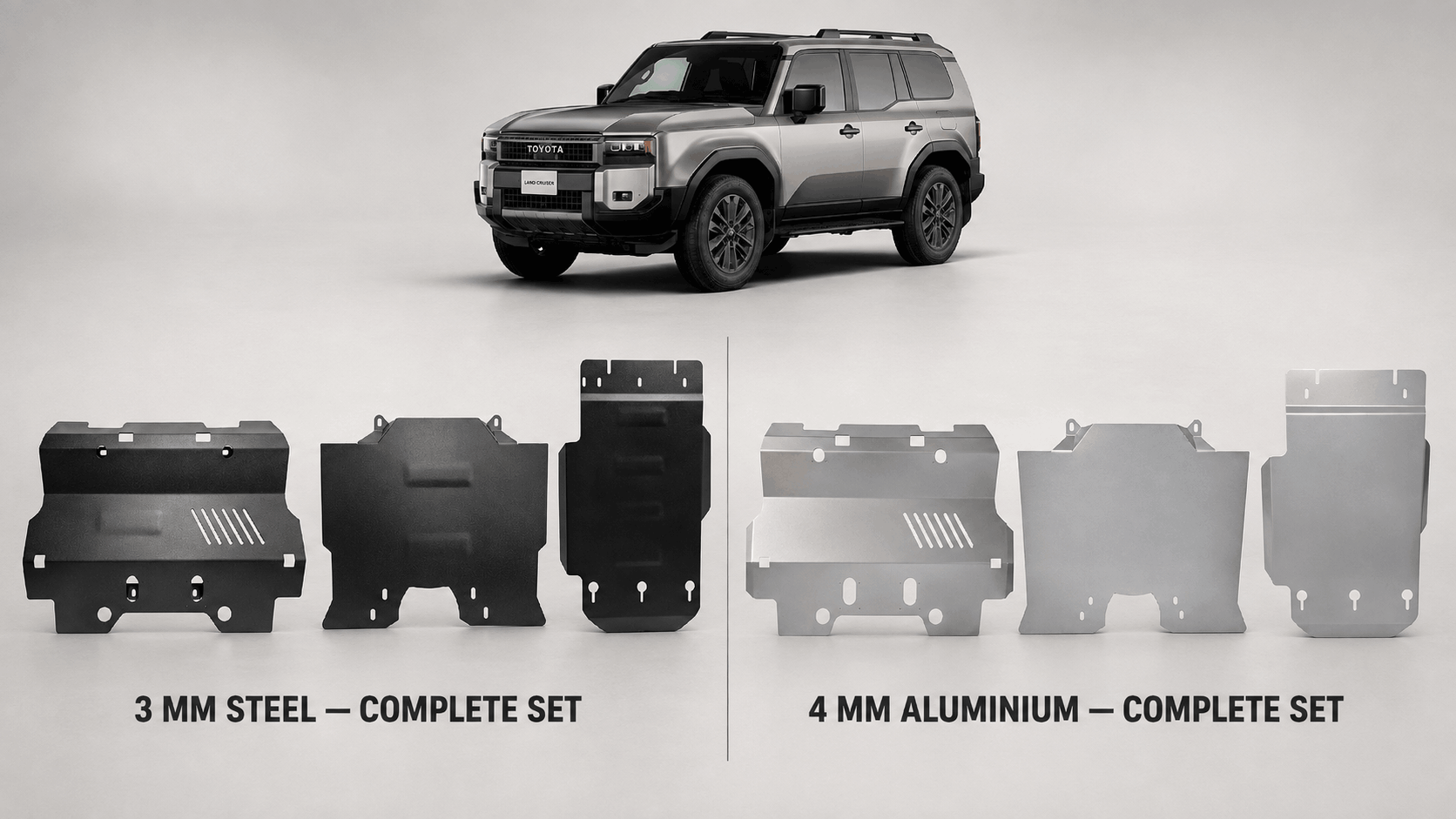
For repeated trail use or remote travel, a complete set is the strongest configuration. UnderbodyGuards lists both:
- a 3 mm steel protection set covering the engine, gearbox, radiator and transfer-case areas;
- a 4 mm aluminium complete underbody protection set covering the engine, gearbox, radiator and transfer-case areas.
A complete set is not automatically required for every owner. It becomes worthwhile when the probability and consequences of centre-vehicle impacts are high enough that leaving the gearbox or transfer case exposed defeats the purpose of protecting only the engine.
Steel or Aluminium for the Land Cruiser 250?
There is no universal winner. The correct choice depends on impact severity, frequency of off-road contact, climate, vehicle load and the total number of plates being installed.
Choose 3 mm Steel When:
- the vehicle regularly encounters rocks, deep ruts or hard trail obstacles;
- maximum resistance to repeated heavy contact is the priority;
- the LC250 is used as a work vehicle on forestry, agricultural or construction routes;
- additional weight is less important than demanding impact protection;
- the owner accepts periodic inspection of the coating, mounting points and damaged surfaces.
Choose 4 mm Aluminium When:
- reducing the added weight of a multi-plate system is important;
- the vehicle is used for mixed road, winter, gravel and moderate off-road driving;
- natural resistance to rust is valuable in wet or salted-road conditions;
- the LC250 already carries touring equipment, recovery gear or other accessories;
- the owner wants broad coverage without choosing steel for every section.
A 4 mm aluminium plate should not be compared with a 3 mm steel plate by thickness alone. Steel and aluminium have different material properties, and real performance also depends on the plate geometry, bends, reinforcement, protected span and mounting design. Read the detailed steel vs aluminium skid plate guide before choosing a complete system.
Protection Setup by Driving Profile
Mostly paved roads: start with engine protection. Add the radiator plate if winter debris, gravel or damaged rural roads are common.
Mixed road and gravel use: protect the engine and radiator first. Add the gearbox and transfer-case plate if the vehicle regularly travels on deeply rutted or uneven tracks.
Frequent off-road use: choose a complete front-to-centre protection system. Steel is the stronger choice when repeated hard impacts are expected; aluminium is attractive when total accessory weight and corrosion resistance are major considerations.
Overland build: calculate the complete added load, including passengers, luggage, roof equipment, recovery gear, auxiliary systems and skid plates. Underbody protection should improve the vehicle’s readiness without ignoring payload and axle-load limits.
Fitment: Why “Land Cruiser 250” Is Not Enough Information
The 250 Series is sold in different markets with different powertrains and equipment. Toyota’s global launch information describes petrol, diesel and hybrid configurations, while individual regional ranges may offer only some of them. Exhaust routing, emissions equipment, underbody hardware and factory-fitted shielding can therefore vary.
Before ordering, verify:
- the complete 17-character VIN;
- production year and sales market;
- engine and transmission;
- drivetrain and trim configuration;
- existing factory protection and any aftermarket modifications;
- the exact protection zones stated on the product page.
Use the GuardPass™ VIN compatibility checker to identify the vehicle and narrow down matching protection. VIN decoding assists selection, but manual confirmation remains advisable where the vehicle has market-specific equipment or modifications.
Installation and Service Considerations
The LC250 skid plates listed above are vehicle-specific products supplied with mounting hardware and installation information. The complete aluminium set is listed as using existing mounting points without drilling. Even with a bolt-on system, correct installation matters as much as material choice.
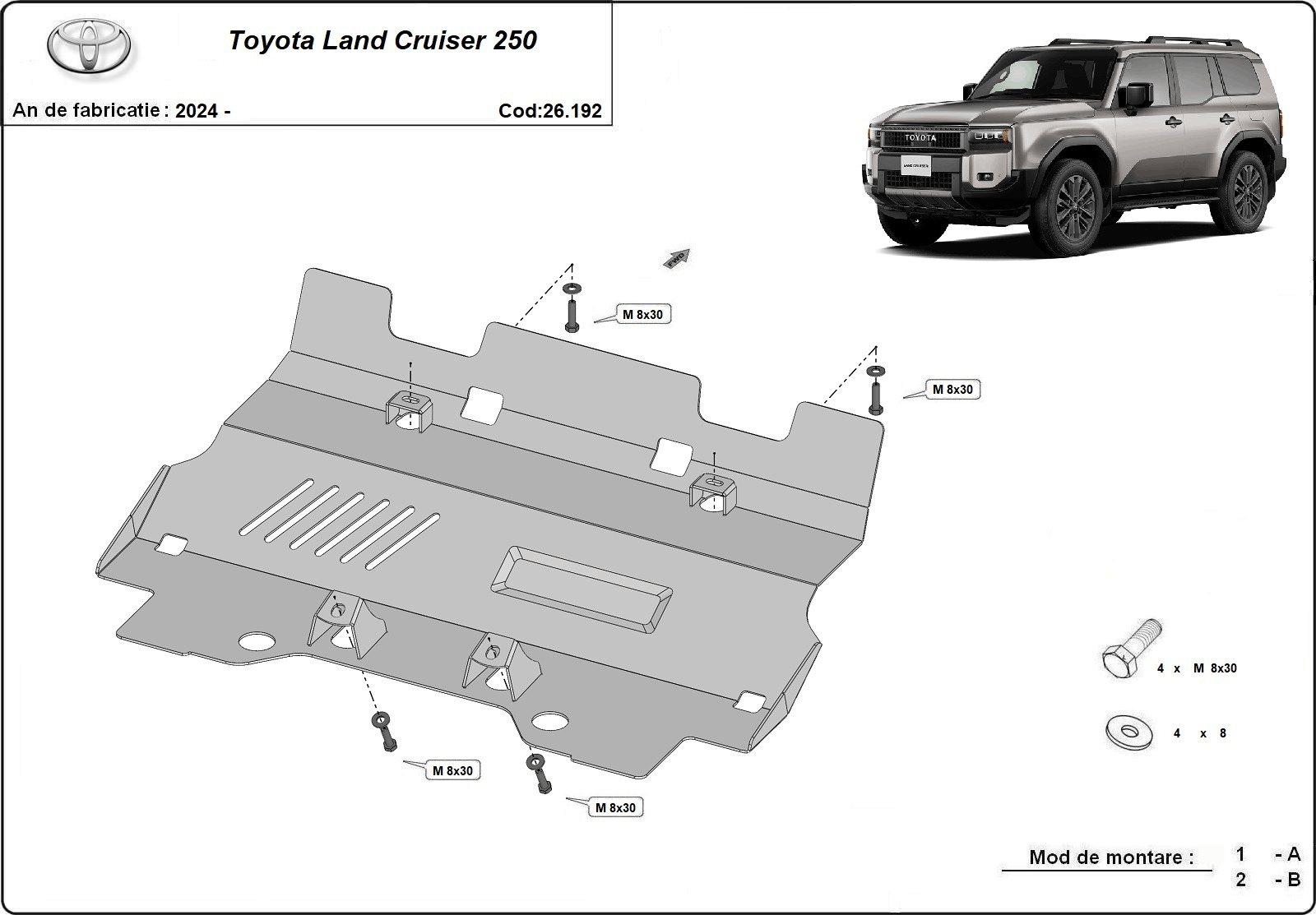
Before installation:
- compare the supplied parts with the installation manual;
- confirm that the mounting points are undamaged and free of heavy contamination;
- check clearance around exhaust, cooling and moving components;
- identify whether a plate must be removed for oil or drivetrain servicing;
- tighten fasteners in the specified sequence and to the specified values;
- recheck the mounting hardware after the initial period of use and after significant impacts.
After off-road or winter driving, remove accumulated mud, stones, packed snow and road salt. Inspect the plate for deformation, damaged coating and contact marks, then check the brackets and fasteners. A skid plate is a working protection component and should be inspected accordingly.
Common Mistakes When Choosing LC250 Underbody Protection
Choosing Only by Material Thickness
Thickness does not show what the plate covers or how it is reinforced. Compare material, geometry, mounting system and protection zone together.
Assuming an Engine Plate Protects the Entire Front Drivetrain
Some plates cover only the engine, while others also cover the front differential. Product names and listed protection zones must be read carefully.
Protecting the Front but Ignoring the Centre
Engine protection is a strong first step, but it does not help the gearbox or transfer case when the vehicle becomes high-centred on a ridge or rock.
Assuming Every LC250 Has the Same Underbody Layout
Powertrain and market differences matter. Confirm the exact vehicle rather than relying only on the model name and year.
Installing Protection and Never Inspecting It
Fasteners can loosen, coatings can be damaged and plates can deform after contact. Inspection is part of using underbody protection correctly.
Final Recommendation
For most Toyota Land Cruiser 250 owners, engine protection is the first priority, followed by the radiator. Drivers who regularly cross deep ruts, rocks or raised terrain should extend protection to the gearbox and transfer case rather than leaving the centre of the drivetrain exposed.
Choose 3 mm steel when repeated hard impacts and demanding work or off-road use are the main concern. Choose 4 mm aluminium when broad coverage, lower added weight and corrosion resistance are more important for mixed road, winter, gravel and moderate off-road use.
If the LC250 is used regularly away from maintained roads, the most coherent solution is a matched complete protection set covering the radiator, engine, gearbox and transfer-case areas. If the vehicle is mainly road-driven, begin with the most critical front section and expand only where the driving conditions justify it.
Browse all Toyota Land Cruiser underbody protection or check the vehicle by VIN before ordering.
Toyota Land Cruiser 250 Skid Plate FAQ
Does the Toyota Land Cruiser 250 need additional skid plates?
It depends on use. The LC250 is a capable body-on-frame 4×4, but exposed underbody components can still be damaged by rocks, deep ruts, road debris or raised terrain. Additional protection is most valuable on gravel roads, worksites, winter routes and off-road trails.
Which skid plate should I install first on an LC250?
Start with the engine area because impact-related oil loss can cause immediate and serious mechanical damage. Radiator protection is the next logical front layer. Add gearbox and transfer-case protection for regular off-road or deeply rutted-road use.
Is 3 mm steel or 4 mm aluminium better?
Choose 3 mm steel for frequent hard impacts, rocky terrain and demanding work use. Choose 4 mm aluminium when lower added weight and corrosion resistance are more important. Plate design, reinforcement and mounting are as important as nominal thickness.
What does a complete LC250 protection set cover?
The complete sets listed by UnderbodyGuards cover the radiator, engine, gearbox and transfer-case areas. Coverage differs between individual plates, so check the exact product specification before ordering.
Does an engine skid plate also protect the front differential?
Not always. The listed 3 mm steel front plate covers the engine and front differential, while the listed 4 mm aluminium engine plate specifies engine coverage. Do not assume identical coverage simply because both products fit the same vehicle.
Will LC250 skid plates fit every engine version?
The linked products are listed for 2024–2026 vehicles and their pages state the applicable engine compatibility. Because regional powertrains and underbody equipment can differ, confirm the VIN, engine, drivetrain and market specification before ordering.
Do skid plates require maintenance?
Yes. Clean away mud, salt, stones and packed snow, then inspect the plates, brackets and fasteners. Recheck the system after a significant impact and according to the supplied installation guidance.
