Toyota Land Cruiser 250 Gearbox and Transfer Case Protection Guide
An engine skid plate does not protect the entire drivetrain of a Toyota Land Cruiser 250. Behind the front protection zone, the gearbox and transfer case remain farther back along the centre of the vehicle. On uneven tracks, this area can contact a crest, embedded rock or deep rut after the front axle has already passed the obstacle.
For the LC250, UnderbodyGuards offers combined gearbox and transfer case protection in 3 mm steel and 4 mm aluminium. Both versions cover the same two drivetrain zones. The steel version is listed at 10 kg and the aluminium version at 5 kg. The practical choice depends on weight, impact type, corrosion exposure and how the vehicle is used.
Short Answer: When Does the LC250 Need Centre-Drivetrain Protection?
Gearbox and transfer case protection is most relevant when an LC250 regularly travels on rutted tracks, rocky surfaces, forestry roads, worksites or remote routes where the underside may make contact with the ground. It is also a logical second stage for a vehicle that already has engine protection but still has an unprotected gap farther back.
A mainly road-driven vehicle with no realistic underbody contact risk may not require the same level of coverage. However, if the vehicle is used off road, heavily loaded or driven through terrain with pronounced crests, protecting only the front section leaves the centre drivetrain exposed.
Gearbox and Transfer Case: Two Different Components, One Protection Zone
The gearbox and transfer case perform different jobs. The gearbox uses different ratios to transmit engine output efficiently across the vehicle’s speed range. The transfer case is part of the four-wheel-drive system and distributes drive toward the front and rear axles.
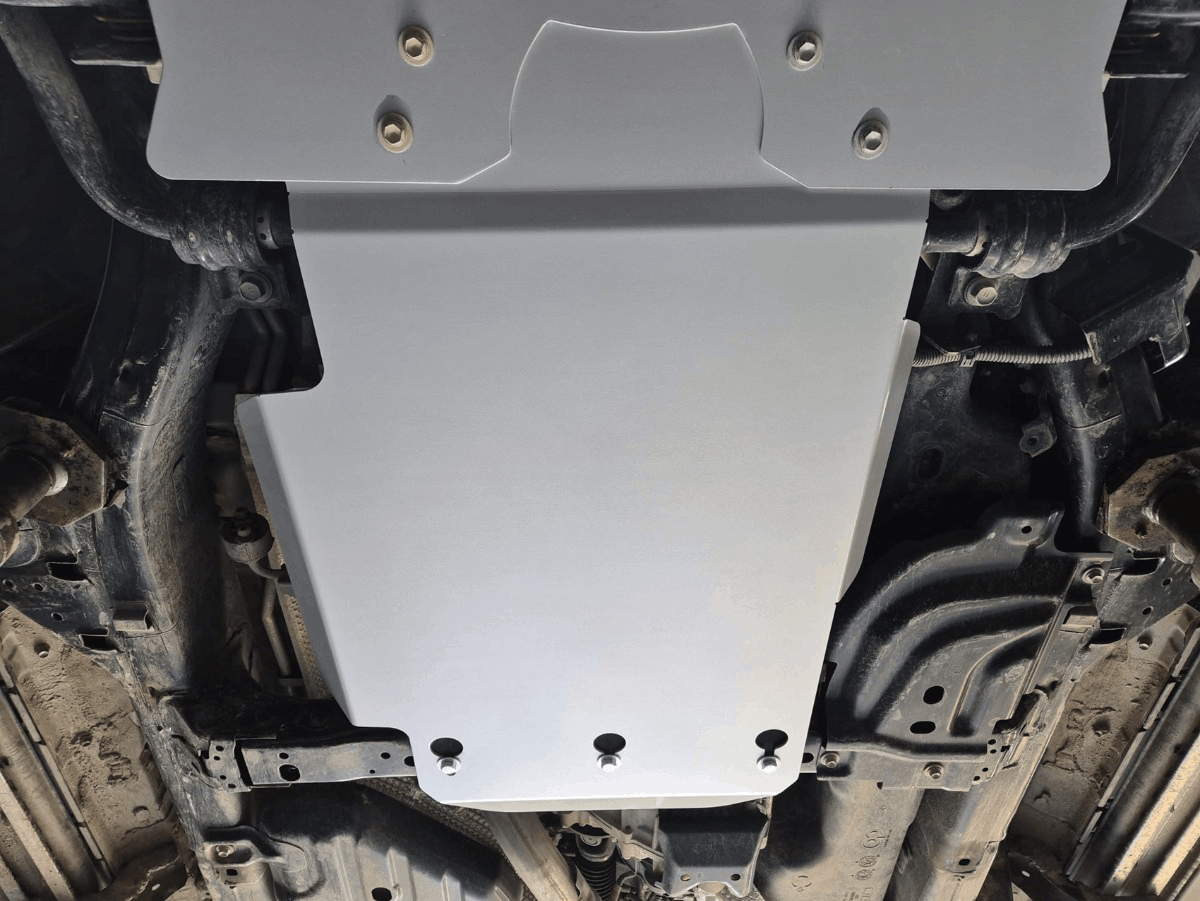
Although they are separate assemblies, they occupy neighbouring areas under the vehicle. A combined LC250 skid plate creates a continuous protective surface beneath both zones instead of treating them as unrelated targets. This matters because an obstacle sliding beneath the centreline does not follow component boundaries.
Why the Centre of the Vehicle Can Strike an Obstacle
Drivers naturally watch the front bumper and front wheels, but centre-underbody contact often happens later in the obstacle sequence. The front wheels climb over a ridge or rock, the vehicle moves forward, and the raised surface then passes beneath the space between the axles.
Common centre-contact situations include:
- Crossing a sharp crest: the vehicle can become supported near its centre as the axles sit on opposite slopes.
- Driving through deep ruts: the wheels drop lower while the centre ridge remains close to the drivetrain.
- Passing an embedded rock: the front section may clear it, but the rock can enter the central path under the vehicle.
- Travelling heavily loaded: passengers, cargo and overlanding equipment reduce the available suspension margin.
- Sliding over uneven ground: a longer contact can scrape or load several points rather than producing one clean impact.
The purpose of the plate is to receive and spread this contact before it reaches the protected housings. It does not make the vehicle immune to damage, and it is not a substitute for careful wheel placement, but it adds a sacrificial barrier in a difficult-to-see area.
LC250 Steel and Aluminium Gearbox Protection Compared
| Specification | 3 mm steel | 4 mm aluminium |
|---|---|---|
| Protected areas | Gearbox and transfer case | Gearbox and transfer case |
| Listed weight | 10 kg | 5 kg |
| Material and thickness | 3 mm steel | 4 mm aluminium |
| Listed vehicle years | 2024–2026 | 2024–2026 |
| Engine listing | All engine variants | All engine variants |
| Kit contents | Mounting hardware and installation manual | Mounting hardware and installation manual |
| Primary selection reason | Repeated or concentrated contact in demanding terrain | Lower listed weight and corrosion resistance for wet, winter and mixed use |
Weight Difference: Steel 10 kg, Aluminium 5 kg
The 3 mm steel gearbox and transfer-case skid plate is listed at 10 kg, while the 4 mm aluminium version is listed at 5 kg. The aluminium version therefore adds 5 kg less weight.
Both products list gearbox and transfer-case protection. Choose between them using the confirmed vehicle fitment, material, mounting design and intended use. Weight and thickness alone do not establish an impact-resistance rating.
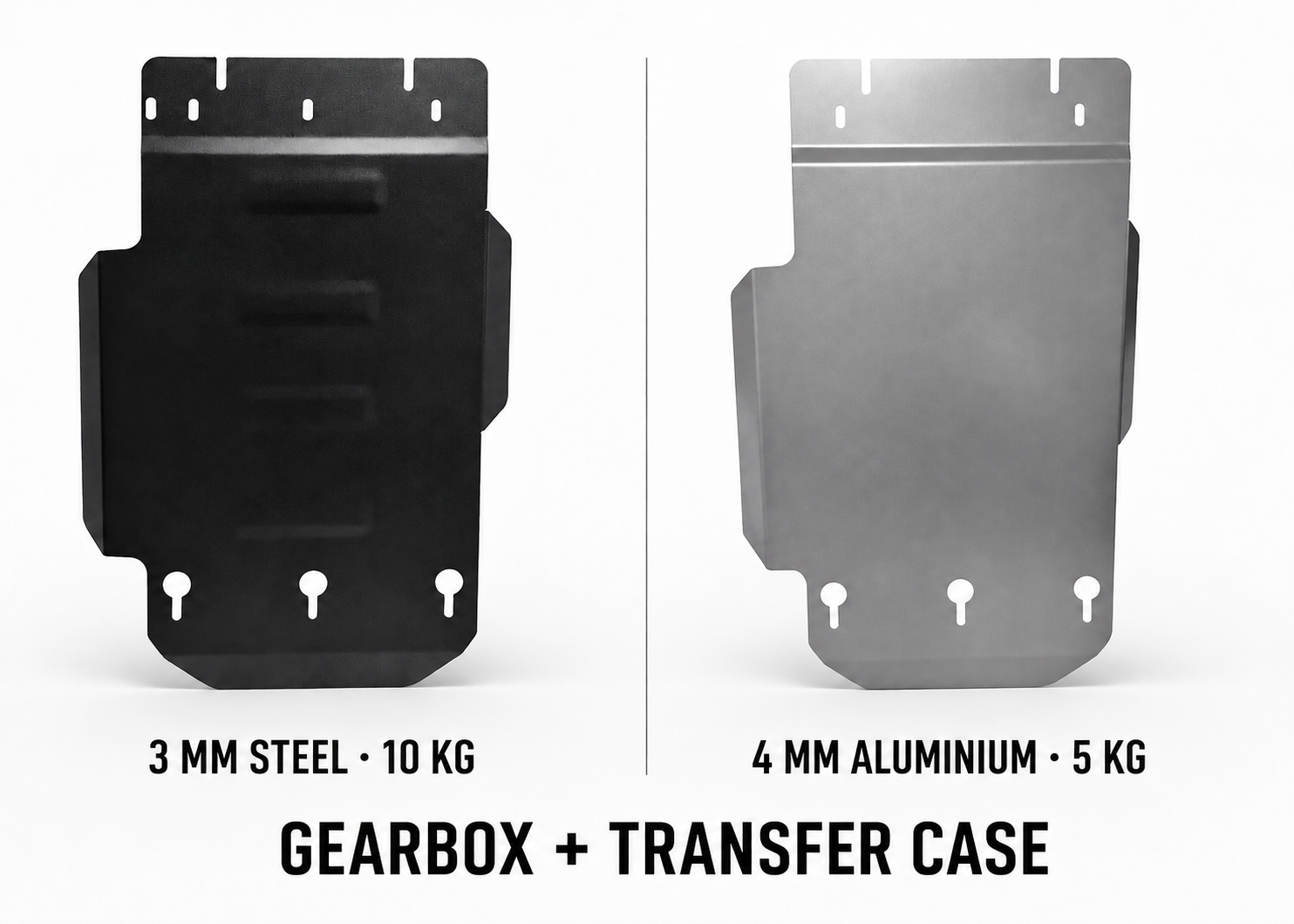
The 4 mm figure also does not make the aluminium plate automatically stronger than the 3 mm steel version. Thickness values from different materials cannot be ranked in isolation. Plate shape, bends, reinforced sections, unsupported span, brackets and mounting points all influence how the finished guard manages a load. For the broader engineering trade-offs, see the steel versus aluminium skid plate guide.
When 3 mm Steel Is the Better Match
The steel version is the more logical choice when the centre of the vehicle may see repeated hard contact with rocks, sharp ridges or compacted ground. Typical examples include rocky off-road routes, forestry work, construction access roads and heavily loaded travel on deeply rutted tracks.
Steel is commonly selected for its resistance to concentrated impacts and repeated scraping. Its surface protection still needs attention: inspect chips, deep scratches and exposed areas, especially after winter driving or contact with abrasive terrain. Cleaning mud and road salt from the plate and the mounting points is part of long-term maintenance.
When 4 mm Aluminium Is the Better Match
The aluminium version is well suited to mixed road and trail use where corrosion resistance and lower added weight are priorities. This can include wet climates, salted winter roads, gravel routes and occasional off-road travel without frequent severe centre contact.
Aluminium does not rust like steel, but the complete installation should still be inspected. Mounting brackets, fasteners and contact points may include other materials, and trapped mud or salt should not be left between the plate and the vehicle. At a listed weight of 5 kg, the aluminium version is 5 kg lighter than the 10 kg steel version.
Why Front Protection Alone Leaves a Gap
The engine and front differential occupy the forward protection zone. The gearbox and transfer case sit farther back. Installing a front skid plate therefore does not automatically create continuous coverage beneath the centre drivetrain.
If your vehicle already has front protection, use the LC250 engine and front differential protection guide to confirm what the first plate covers. The combined gearbox and transfer case plate can then extend protection rearward across the next vulnerable zone.
Individual Centre Plate or Complete Protection Set?
An individual gearbox and transfer case plate makes sense when the vehicle already has compatible front protection or when centre-underbody contact is the main unresolved risk. It also allows protection to be built in stages.
A complete system is more appropriate when the LC250 currently has no substantial underbody protection and the vehicle will regularly face varied obstacles. UnderbodyGuards lists a 3 mm steel complete set and a 4 mm aluminium complete set covering the engine, radiator, gearbox and transfer case areas.
Before ordering separate plates for a staged build, confirm that the selected parts form the intended protection sequence and use the correct mounting layout. The LC250 complete protection guide explains how the front and centre zones work together.
Which Configuration Fits Your Use?
| Driving scenario | Centre-protection approach | Material direction |
|---|---|---|
| Road use with little realistic underbody contact | Assess actual risk before adding the centre plate | Choose by local conditions if protection is required |
| Road, winter and occasional gravel | Gearbox and transfer case plate where ruts or debris are a concern | 4 mm aluminium offers lower listed weight and corrosion resistance |
| Forestry roads, worksites and deep ruts | Centre protection strongly complements the front plate | 3 mm steel suits repeated or concentrated contact |
| Rocky off-road driving | Continuous front-to-centre coverage is preferable | Steel is commonly chosen for demanding impacts |
| Overlanding or remote travel with extra load | Consider a complete set and inspect it throughout the trip | Choose based on route severity, added weight and corrosion exposure |
Fitment Checks Before Ordering
Both individual LC250 products are listed for model years 2024–2026 and all engine variants. That listing should not replace a vehicle-specific check. Market specification, drivetrain details, production changes, previous repairs and non-standard equipment can affect the underbody layout or installation clearance.
Before ordering, confirm:
- the VIN and model year;
- the exact engine and drivetrain specification;
- that existing plates or accessories do not occupy the same mounting points;
- that exhaust, brackets and underbody components are in their standard positions;
- whether the chosen plate is being installed alone or as part of a staged system.
If anything is uncertain, use the GuardPass VIN compatibility check before purchase rather than modifying a plate that does not match the vehicle.
Installation and Clearance
Both versions are supplied with mounting hardware and an installation manual. The plate should align with the specified mounting points before final tightening. It should not need to be forced into position, and it must maintain clearance from the gearbox, transfer case, exhaust and any part that moves during normal driving.
Do not substitute guessed torque values or a generic tightening sequence for the supplied instructions. Follow the product manual and the vehicle manufacturer’s service information where applicable. If the installer cannot confirm alignment, clearance or hardware placement, use a professional workshop.
After installation, check that:
- all fasteners are installed in the correct locations;
- the plate is stable and cannot be moved by hand;
- there is no contact with the drivetrain or exhaust;
- no new rattle or vibration appears during driving;
- drainage and service-access requirements have been confirmed.
Inspection After a Strike
A skid plate should be inspected after a significant impact. Look for deformation toward the protected components, shifted brackets, loose or missing fasteners, fresh contact marks and trapped stones. Listen for rattles or vibration and stop driving if the plate is pressing against the drivetrain, exhaust or another moving or heat-sensitive component.
Also inspect the plate periodically when the vehicle is used in mud, snow or salted conditions. Remove accumulated material that can hold moisture, conceal damage or create noise. A guard is a working component, not a fit-and-forget cosmetic accessory.
Final Recommendation
Choose the LC250 gearbox and transfer case skid plate when the central drivetrain remains exposed behind the front protection zone. Both versions list the same protected areas: the 3 mm steel plate weighs 10 kg, while the 4 mm aluminium plate weighs 5 kg. Confirm compatibility with the vehicle and any existing protection before ordering.
Select steel for frequent hard, concentrated or repeated ground contact. Select aluminium when lower added weight and corrosion resistance are priorities and the vehicle sees wet, winter, gravel and mixed-use conditions. For regular off-road or remote travel, evaluate the centre plate as part of a continuous protection system rather than as an isolated accessory.
Browse the full Toyota Land Cruiser underbody protection range or confirm the exact vehicle by VIN before ordering.
FAQ
Does an LC250 engine skid plate also protect the gearbox?
No. The engine and gearbox occupy different underbody zones. Check the stated coverage of each product rather than assuming that a front plate extends beneath the centre drivetrain.
Does one LC250 plate protect both the gearbox and transfer case?
Yes. The steel and aluminium products covered in this guide are combined plates designed for both the gearbox and transfer case areas.
Which version is lighter?
The 4 mm aluminium version is lighter: its listed weight is 5 kg, compared with 10 kg for the 3 mm steel version. Choosing aluminium reduces the listed weight by 5 kg.
Is 4 mm aluminium stronger than 3 mm steel?
Thickness alone cannot answer that question because the materials behave differently. Finished performance also depends on plate geometry, reinforcement, span, brackets and mounting points.
Which material is better for rocky tracks?
Steel is commonly chosen where repeated hard or concentrated rock contact is likely. The final choice should still account for route conditions, corrosion exposure and maintenance.
Which material is better for winter roads?
Aluminium is attractive in wet and salted conditions because it does not rust like steel. Fasteners, brackets and trapped salt still require inspection and cleaning.
Are these plates listed for every LC250 engine?
Both products are listed for 2024–2026 vehicles and all engine variants. Confirm the VIN, market specification, drivetrain and underbody layout before ordering.
Is mounting hardware included?
Yes. Both product listings specify mounting hardware and an installation manual.
Should the plate touch the gearbox or transfer case?
No. Correct clearance is required. A plate that contacts a drivetrain component or exhaust can create noise, vibration or impact-transfer problems.
Should I buy the individual plate or a complete set?
Choose the individual plate when compatible front protection is already installed or the centre zone is the specific gap you need to close. Consider a complete set when the engine, radiator and centre drivetrain all require protection.
