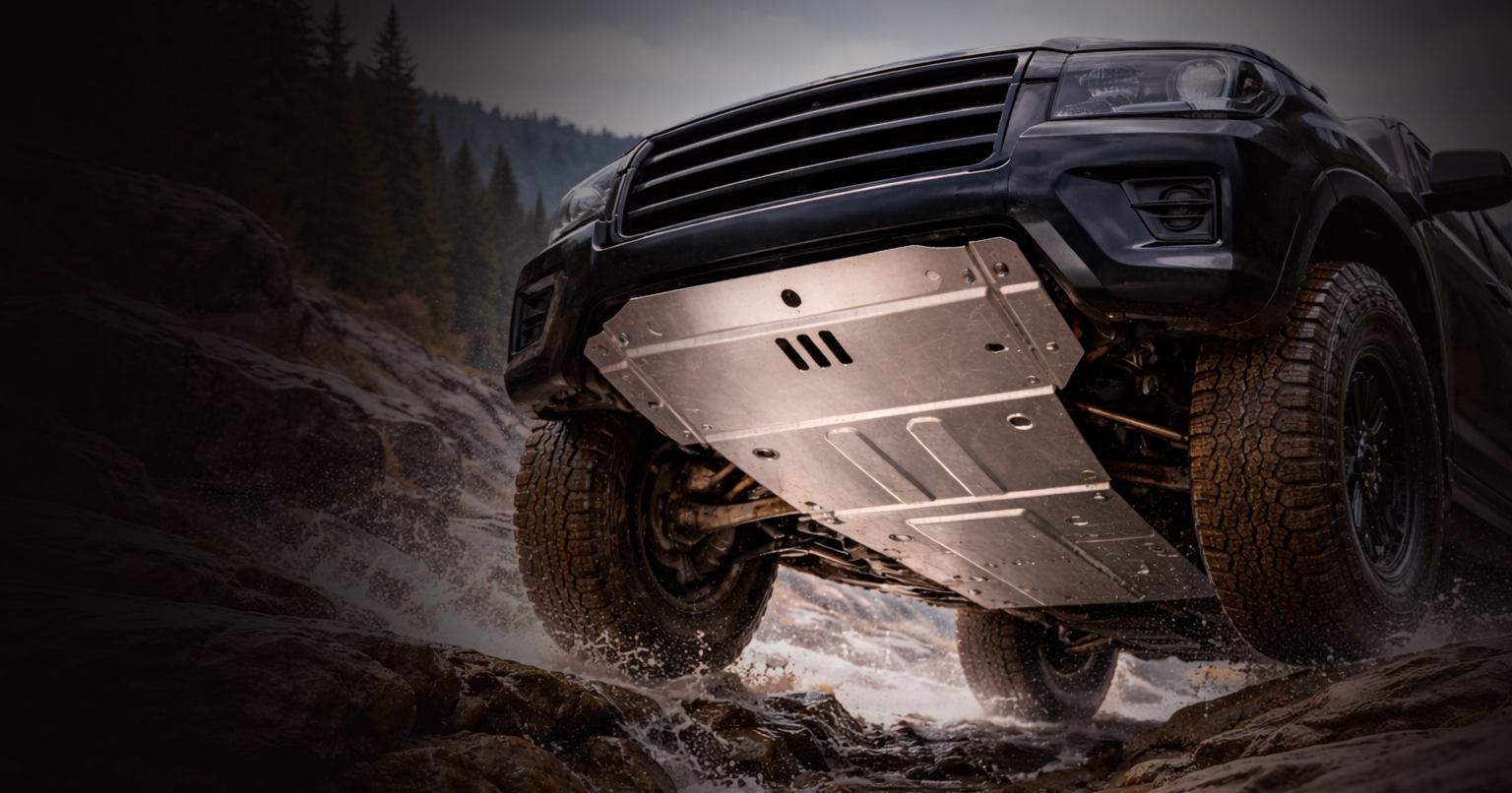
Toyota Land Cruiser 250 Engine and Front Differential Protection Guide
An engine skid plate and a front differential skid plate are not automatically the same thing. On the Toyota Land Cruiser 250, the decisive question is not only whether a plate is made from steel or aluminium, but exactly how far its listed coverage extends beneath the front drivetrain.
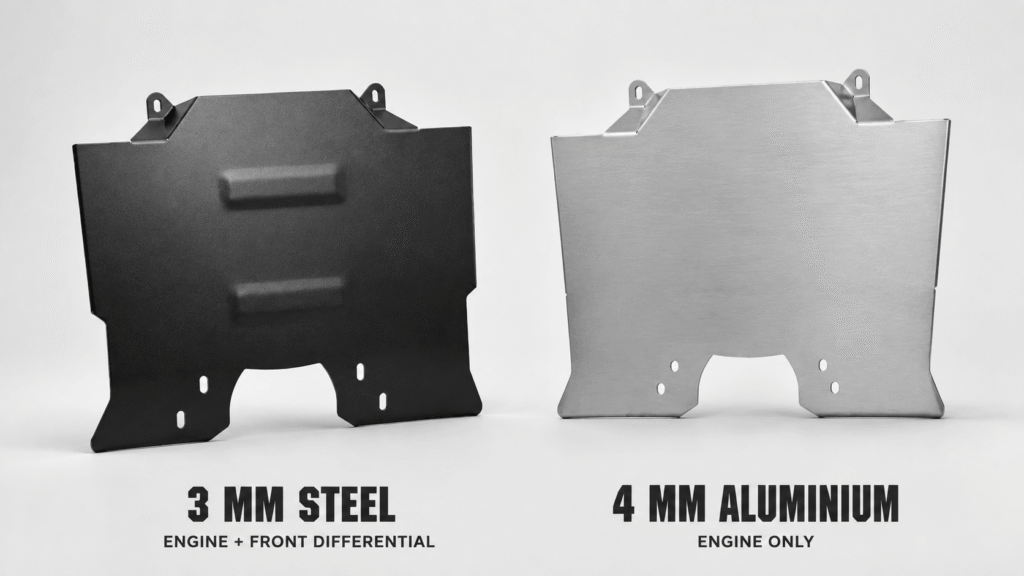
UnderbodyGuards currently lists two relevant front protection options for the LC250. The 3 mm steel skid plate explicitly protects the engine and front differential, while the 4 mm aluminium skid plate is listed for the engine area. Both products are listed at approximately 10 kg, so weight alone does not reveal which one provides the coverage required for a particular vehicle and driving profile.
This guide explains the difference between engine-only and engine-plus-front-differential protection, when the wider steel coverage is useful, when an aluminium engine plate may be sufficient, and what should be checked before installation.
Short Answer: Which Front Skid Plate Should You Choose?
Choose the 3 mm steel engine and front differential skid plate when the LC250 is regularly used on rocky tracks, deep ruts, forestry roads, worksites or routes where the front drivetrain may contact raised ground. Its key advantage is not simply the material: the listed coverage specifically includes the front differential.
Choose the 4 mm aluminium engine skid plate when the priority is protecting the engine area during road driving, winter use, gravel travel and occasional moderate off-road use, and separate front-differential coverage is not required. Aluminium also offers natural resistance to rust, but this specific product should not be assumed to protect an area that is not included in its listing.
If the intended use extends beyond the front section, neither plate creates complete underbody protection by itself. Radiator, gearbox and transfer-case protection must be considered separately. See the Toyota Land Cruiser 250 complete protection guide for the full front-to-centre protection sequence.
Engine Protection and Front Differential Protection Are Different Jobs
The engine underside and the front differential belong to the same general front underbody zone, but they are separate components with different exposure patterns. A product described only as an engine skid plate should therefore be evaluated according to its stated coverage, not according to assumptions based on its overall size or appearance.
What the Engine Skid Plate Protects
The engine plate creates a barrier beneath the lower engine area. Its purpose is to take the initial contact from stones, broken road surfaces, compacted snow, raised ground and other obstacles before those hazards reach vulnerable engine components from below.
A direct impact beneath the engine can damage the sump or surrounding lower components. If a strike causes oil loss, continuing to run the engine can turn a local impact into a much more serious mechanical problem. A skid plate reduces the likelihood of direct contact and spreads a load through the formed plate and its mounting structure.
What Front Differential Protection Adds
The front differential is part of the front drivetrain. On rough terrain, it can be approached by obstacles that pass beneath a wheel but remain high near the vehicle centreline. A deep rut, embedded rock or raised ridge can therefore miss the tyre and still contact the lower drivetrain area.
Front-differential protection extends the guarded zone beyond the basic engine area. This matters because an impact to the differential housing or adjacent components may lead to deformation, seal damage or lubricant loss. The severity depends on the impact and contact point, but remote recovery becomes much more difficult if the front drivetrain is compromised.
For a broader explanation of when front or rear differential protection is worth adding, see our differential skid plate guide, covering drivetrain-specific fitment, deep ruts, gravel roads, winter conditions and impact exposure.
LC250 Front Protection Specifications
The following comparison uses the current listed specifications for the two Toyota Land Cruiser 250 front skid plates. It shows why product coverage must be checked before comparing material thickness.
| LC250 front protection | 3 mm steel | 4 mm aluminium |
|---|---|---|
| Listed protection area | Engine and front differential | Engine |
| Material | Steel | Aluminium |
| Thickness | 3 mm | 4 mm |
| Listed weight | Approximately 10 kg | Approximately 10 kg |
| Model years | 2024–2026 | 2024–2026 |
| Engine compatibility | Listed for all engine variants | Listed for all engine variants |
| Oil sump opening | No | No |
| Product SKU | 5941986215765 | 5941986215734 |
Why the Identical Listed Weight Does Not Mean Identical Protection
Both plates are listed at approximately 10 kg, but they should not be treated as equivalent products. The steel version covers two specified areas, while the aluminium version covers one. Material density is only one part of total product weight. Plate dimensions, coverage, bends, reinforcement, unsupported spans and mounting geometry all affect the finished design.
This is a useful example of why choosing a skid plate by thickness or weight alone can lead to the wrong conclusion. Four millimetres of aluminium is not automatically a wider or more complete protection solution than three millimetres of steel. The correct comparison is:
- which components the finished plate is designed to cover;
- how the plate is formed and reinforced;
- where it attaches to the vehicle;
- how much clearance remains around protected components;
- what type of contact the vehicle is expected to encounter.
For a broader material analysis, see the LC250 steel vs aluminium skid plate comparison.
When Engine-Only Protection May Be Sufficient
An engine-only plate can be a rational first step when the vehicle spends most of its time on paved roads and the expected hazards are potholes, loose debris, compacted snow, broken asphalt, shallow gravel and occasional uneven access roads.
The 4 mm aluminium engine plate is particularly relevant when:
- the main objective is to create a durable barrier beneath the engine area;
- the vehicle is used primarily for road, winter and mixed-surface travel;
- natural resistance to rust is valued;
- frequent contact with deep ruts or large rocks is not expected;
- the owner has confirmed that engine-only coverage matches the intended use.
Engine-only protection should not be described as inadequate simply because it excludes the front differential. It is a different configuration for a different risk profile. The important point is that the buyer understands the boundary of the protected area before ordering.
When Engine and Front Differential Protection Is the Better Choice
The 3 mm steel engine and front differential plate is the more comprehensive front-coverage configuration when the route creates a realistic chance of contact beneath the forward drivetrain. This includes vehicles used on rocky tracks, forest roads, worksites, deeply rutted lanes and remote routes where avoiding every centreline obstacle is not always possible.
Wider front coverage is particularly useful when:
- the LC250 regularly crosses deep wheel ruts with a raised centre;
- rocks or roots can pass between the tyres;
- the vehicle is driven while heavily loaded on uneven terrain;
- the underside may slide over a ridge rather than receive only loose-debris impacts;
- front-differential protection is an explicit requirement of the build.
Steel is commonly selected where resistance to repeated concentrated contact is more important than corrosion resistance or minimum weight. The protective finish should still be inspected after impacts because surface damage can leave the underlying steel exposed to moisture and road salt.
How Front-Underbody Impacts Actually Occur
Many drivers imagine underbody damage as a large rock striking directly beneath the engine. In practice, front protection may be loaded in several different ways.
Raised Centre Between Wheel Tracks
The tyres can travel inside two ruts while the centre of the track rises towards the engine and differential zone. The obstacle may be difficult to judge from the driver’s seat because the wheels remain on apparently passable lines.
Single Rock or Embedded Obstacle
A rock can pass inside one front wheel and contact a lower component before the driver can change direction. Concentrated contact places a greater local load on the plate than loose gravel or small debris.
Sliding Contact
On a crest or uneven transition, the plate may first contact the ground and then slide across it. A smooth, properly mounted plate can help the vehicle move over the obstacle, but the driver should not intentionally use underbody protection as a substitute for route selection.
Road and Winter Debris
Broken asphalt, compacted ice, frozen ruts and objects thrown beneath the vehicle can strike the front underside even when the LC250 never enters a technical off-road trail. These impacts are usually less severe than direct rock contact but occur at higher road speeds.
What a Skid Plate Can and Cannot Do
A vehicle-specific skid plate creates physical separation and a load-distributing barrier between an obstacle and the protected component. Bends and reinforcement increase stiffness, while mounting points transfer loads into the supporting vehicle structure.
It does not make the underside indestructible. A sufficiently severe impact can deform the plate, damage brackets, stretch mounting holes or reduce clearance to the protected component. The correct objective is to reduce the chance and severity of direct component damage, not to encourage harder impacts.
After a significant strike, inspect:
- clearance between the plate and the engine or drivetrain;
- mounting bolts, washers and brackets;
- elongated mounting holes or cracked attachment points;
- new vibration, resonance or contact noise;
- damage to the protective finish on steel protection;
- trapped mud, stones, salt or vegetation.
Installation and Service Access
Both LC250 front plates are listed as vehicle-specific, supplied with mounting hardware and designed to use existing mounting points without drilling. The product and supplied installation information should still be matched to the exact vehicle before fitting.
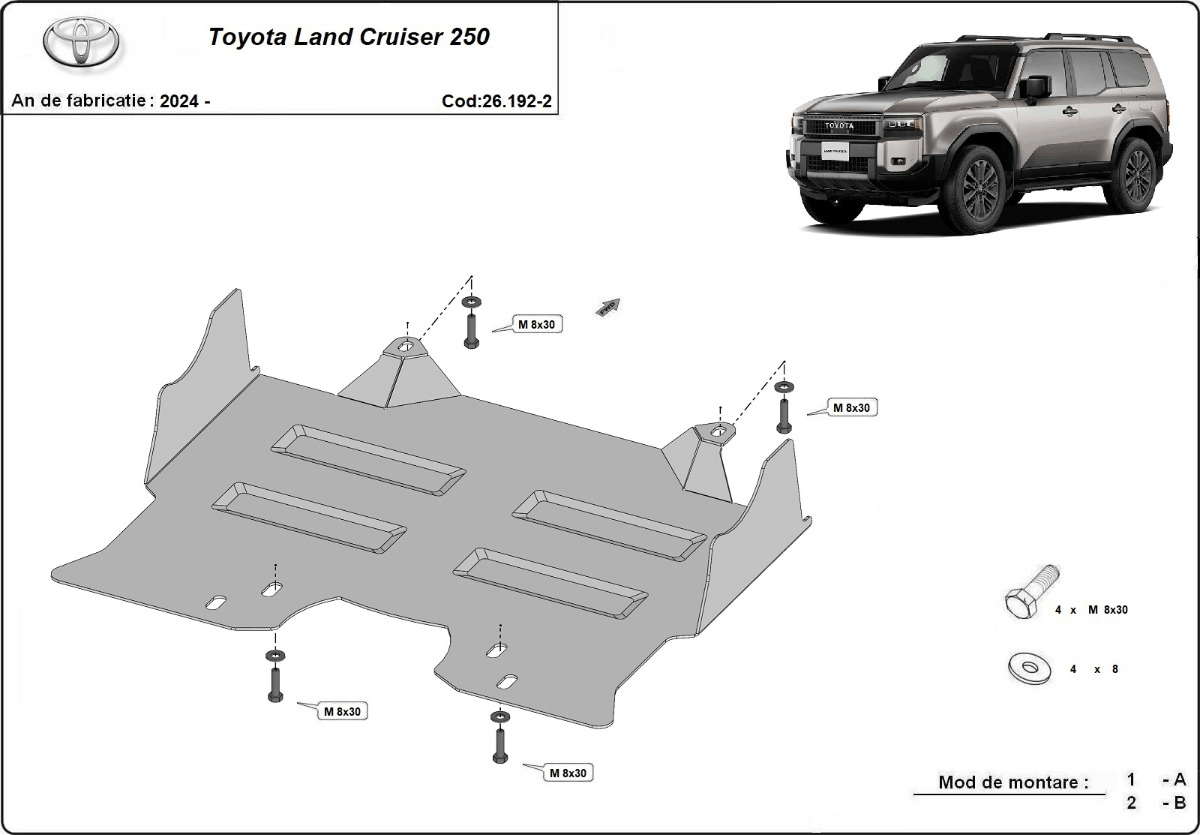
The available mounting drawing for the 3 mm steel engine and front differential plate identifies four M8×30 fasteners with washers. Use the supplied hardware arrangement and installation manual for the selected product. Do not infer tightening torque from the bolt size; follow the instructions supplied with the kit or the applicable workshop specification.
Neither front plate is listed with an oil sump opening. Depending on the required service operation, the plate may need to be removed to obtain access. Confirm the service procedure in advance rather than discovering the access limitation during an oil change.
Before installation:
- confirm the VIN, model year, engine and drivetrain;
- check the underbody for previous repairs or non-standard equipment;
- compare the supplied plate and hardware with the installation drawing;
- verify that mounting points are clean and undamaged;
- confirm clearance around the engine, differential, exhaust and moving components.
Should You Add Radiator, Gearbox and Transfer-Case Protection?
Engine protection is a common starting point, but it does not cover every exposed area beneath the LC250. A separate radiator plate protects the lower cooling-system zone ahead of the engine section. Gearbox and transfer-case protection then extends coverage rearwards along the centre drivetrain.
For road and occasional gravel use, an engine plate may be a practical starting point. For regular rough-road, worksite or off-road driving, isolated front protection can leave the centre drivetrain exposed. In those conditions, consider the complete protection path:
- radiator and lower front area;
- engine and, where required, front differential;
- gearbox;
- transfer case.
UnderbodyGuards lists complete LC250 systems in 3 mm steel and 4 mm aluminium. Always compare the exact listed coverage of the complete set with the individual plates rather than assuming every combination protects identical areas.
Recommended Front Protection by Driving Profile
| Driving profile | Front protection priority | Why |
|---|---|---|
| Daily road and winter use | Engine protection | Creates a barrier against potholes, broken asphalt, ice and road debris |
| Gravel and occasional uneven access roads | Engine protection; assess front-differential exposure | Risk depends on rut depth, obstacle height and route frequency |
| Forestry roads and worksites | Engine and front differential | Raised centres, embedded stones and repeated uneven-ground contact are more likely |
| Rocky off-road use | Engine and front differential, plus radiator and centre drivetrain | Single-zone protection leaves adjacent front and centre components exposed |
| Remote travel and overlanding | Choose according to route severity, then extend coverage rearwards | Recovery consequences matter more when assistance is distant |
Fitment: Confirm More Than “Land Cruiser 250”
The products are listed for Toyota Land Cruiser 250 model years 2024–2026 and all engine variants, but compatibility should still be checked before ordering. Market specification, drivetrain, previous repairs, aftermarket bumpers, suspension changes and non-standard underbody equipment can affect the installation environment.
Use the GuardPass™ VIN compatibility checker or provide the VIN for manual confirmation. When front-differential protection is required, state this explicitly rather than requesting only an “engine plate”.
Final Recommendation
For an LC250 used mainly on paved roads, winter roads and occasional gravel, the 4 mm aluminium engine skid plate provides targeted engine-area protection and corrosion resistance. It should be selected with the understanding that its listing does not specify front-differential coverage.
For an LC250 used on rutted tracks, rocky terrain, forestry roads, worksites or demanding remote routes, the 3 mm steel engine and front differential plate is the more complete front-drivetrain choice. Its decisive advantage is explicit coverage of both the engine and front differential, not merely the difference between 3 mm and 4 mm material thickness.
Before ordering, decide which components must be protected, confirm the exact product by VIN and consider whether radiator, gearbox and transfer-case protection should be added. You can review all available options in the Toyota Land Cruiser underbody protection category.
Toyota Land Cruiser 250 Engine and Front Differential Protection FAQ
Does every LC250 engine skid plate protect the front differential?
No. Coverage depends on the specific product. The listed 3 mm steel front plate protects the engine and front differential, while the listed 4 mm aluminium front plate specifies the engine area. Check the product description rather than relying on the generic term “engine skid plate”.
Which listed LC250 plate includes front-differential protection?
The 3 mm steel Toyota Land Cruiser 250 plate, SKU 5941986215765, explicitly lists protection for the engine and front differential.
Is the 4 mm aluminium engine plate lighter?
Not according to the current individual-product listings. Both the 3 mm steel engine and front differential plate and the 4 mm aluminium engine plate are listed at approximately 10 kg. Their coverage and geometry differ, so the identical listed weight does not make them equivalent.
Is aluminium unsuitable for LC250 off-road use?
No. Aluminium can provide durable protection with natural resistance to rust. The important limitation in this comparison is product coverage: the listed 4 mm aluminium plate specifies the engine area, while the listed 3 mm steel plate also includes the front differential. Choose according to the required protected zones and expected impacts.
Do the LC250 front plates require drilling?
The products are listed as vehicle-specific bolt-on protection using existing mounting points, with installation hardware and instructions supplied. Check the exact vehicle and mounting points before fitting.
Do the plates have an oil sump opening?
No. Both listed front plates specify no oil sump opening. Review the required service procedure and allow for plate removal where necessary.
Are the plates listed for every LC250 engine?
Both products are listed for model years 2024–2026 and all engine variants. VIN, market specification, drivetrain and underbody layout should still be confirmed before ordering.
Should radiator protection be installed before the engine plate?
The radiator and engine are separate protection zones. An engine plate protects the lower engine area, while a radiator plate protects the lower front cooling-system area. Vehicles regularly used off-road or in remote conditions benefit from assessing both zones rather than treating either plate as complete front protection.
When should gearbox and transfer-case protection be added?
Add centre-drivetrain protection when the LC250 regularly travels over deep ruts, rocky tracks, worksites or uneven terrain where contact can continue behind the engine area. A complete system provides a more continuous protected path beneath the vehicle.
