Can Potholes Damage the Oil Sump, Gearbox or Underbody?
Potholes can damage far more than tyres and wheels. A deep hole, broken road edge or collapsed section of asphalt can allow the underside of a vehicle to strike the road, exposing the oil sump, gearbox, radiator, exhaust system and other low-mounted components to direct impact.
The severity of the damage depends on the depth and shape of the pothole, vehicle speed, ground clearance, suspension movement, tyre size, vehicle load and the location of vulnerable components beneath the vehicle. Some impacts leave only scratches. Others can crack an oil sump, deform a gearbox casing, damage an exhaust component or cause a fluid leak that makes continued driving unsafe.
Understanding which parts are exposed and what to inspect after an impact can prevent a relatively small incident from becoming an expensive engine or transmission failure.
How a pothole can reach the underside of a vehicle
The first contact with a pothole normally occurs at the tyre and wheel. As the wheel drops into the hole and then meets its far edge, the suspension compresses rapidly.
A hard impact may damage the tyre, wheel, suspension or steering alignment. However, the vehicle can also move low enough for the underside to contact the road surface or the raised edge of the pothole.
This is more likely when:
- The pothole is deep or has a sharp outer edge.
- The vehicle enters the hole at higher speed.
- The suspension is already compressed by passengers or cargo.
- The vehicle has limited ground clearance.
- The tyres have a low sidewall or incorrect pressure.
- The road contains several connected holes or raised sections.
- The driver brakes heavily immediately before the impact.
Heavy braking transfers weight towards the front axle and compresses the front suspension. If the vehicle cannot safely avoid the pothole, reducing speed beforehand and keeping the vehicle stable may help limit the impact.
Can a pothole crack the oil sump?
Yes. The engine oil sump, also called the oil pan, is one of the most vulnerable components beneath many vehicles. It is normally positioned at the bottom of the engine and may be made from pressed steel, aluminium or another cast material.
If the sump strikes a sharp road edge, stone or broken section of asphalt, it may become dented, punctured or cracked. A damaged sump gasket or drain plug area can also begin leaking.
The immediate danger is loss of engine oil. If oil pressure falls and the engine continues running, internal components may lose lubrication. This can cause bearing damage, overheating, seizure or complete engine failure.
Warning signs include:
- Fresh oil beneath the vehicle.
- An oil-pressure warning light.
- A sudden burning-oil smell.
- Smoke caused by oil reaching hot components.
- Abnormal knocking, tapping or mechanical noise.
- A visibly dented or cracked oil sump.
If the oil-pressure warning light appears after an impact, stop the engine as soon as it is safe. Do not continue driving until the oil level and underside have been inspected.
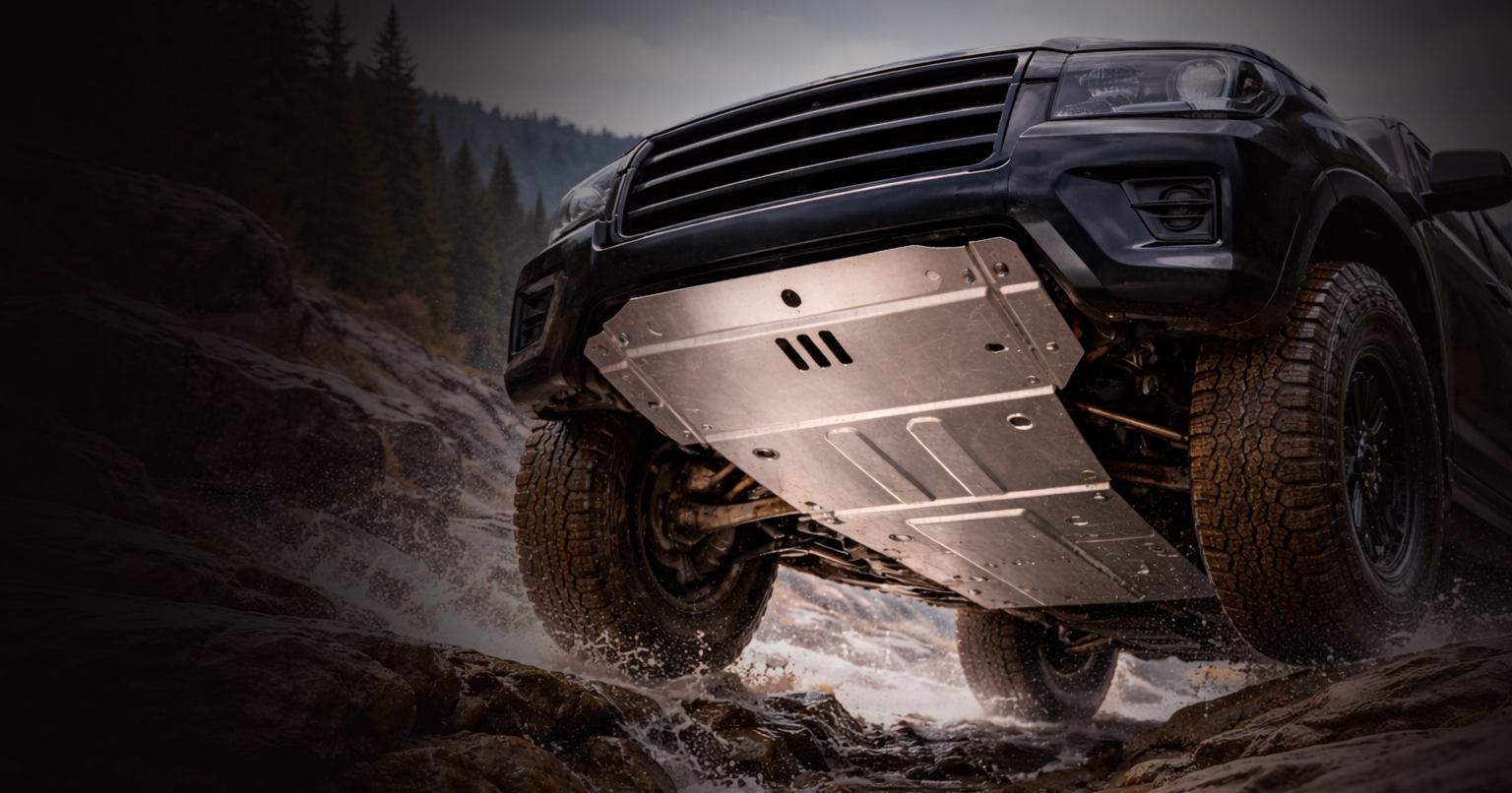
A correctly fitted engine skid plate creates a physical barrier beneath the engine and oil sump. It cannot make a vehicle immune to damage, but it can absorb or distribute many impacts that would otherwise reach the sump directly.
For a vehicle-specific example of broader front protection, the 2 mm steel Toyota RAV4 engine, front bumper, gearbox and radiator skid plate combines several exposed front-underbody zones in one application for selected 2018–2026 vehicles.
Can a pothole damage the gearbox?
A gearbox or transmission can also be damaged if it is positioned low enough to contact a road defect. The casing, oil pan, cooling lines, electrical connectors and mounting points may all be exposed, depending on the vehicle.
Possible damage includes:
- A cracked or deformed gearbox casing.
- A damaged automatic-transmission oil pan.
- Transmission-fluid leakage.
- Damage to wiring, sensors or connectors.
- Deformed brackets or mounting points.
- Contact between the protection plate and gearbox after a severe impact.
Transmission-fluid loss may not always be immediately obvious. The vehicle might initially continue driving before developing delayed gear engagement, harsh shifting, slipping, overheating or warning messages.
If the centre of the vehicle made contact with the road, inspect the gearbox area even when no fluid is visible. Learn when this protection zone should be prioritised in our gearbox skid plate guide.
For an example of dedicated centre-drivetrain protection, see the Toyota Land Cruiser 250 3 mm steel gearbox and transfer-case skid plate, designed to protect the gearbox and transfer-case area on the listed 2024–2026 application.
Which other underbody parts can be damaged?
A pothole impact can affect several areas beyond the engine and gearbox.
Radiator and lower cooling area
The lower radiator, cooling pipes and surrounding components may be exposed near the front of the vehicle. A frontal underbody impact can deform a lower support, damage a hose or create a coolant leak.
For a detailed explanation of when this lower-front area needs additional protection, see our radiator skid plate guide, including pothole, gravel, winter and rough-road exposure.
Watch for rising engine temperature, coolant beneath the vehicle, steam or a coolant warning message.
Exhaust system and catalytic converter
The exhaust system runs beneath much of the vehicle. Contact with a pothole edge can dent a pipe, damage a mounting bracket, crack a joint or deform the catalytic converter or particulate filter housing.
Possible symptoms include rattling, scraping, increased exhaust noise, warning lights or loss of engine performance.
Transfer case and differentials
Four-wheel-drive vehicles may have a transfer case and one or more differentials beneath the drivetrain. These components can be exposed when travelling over broken roads, deep ruts or raised surfaces.
An impact can damage a housing, drain plug, seal or mounting point and may lead to lubricant leakage.
For a more detailed explanation of when front or rear differential protection is useful, see our differential skid plate guide, including drivetrain-specific fitment, deep ruts, gravel roads, winter conditions and impact exposure.
Fuel tank, battery and high-voltage components
Depending on the vehicle, the underside may contain a fuel tank, hybrid battery or electric-vehicle battery enclosure. These areas require vehicle-specific protection and careful inspection after any significant contact.
Do not touch damaged high-voltage components, exposed cables or a visibly damaged EV or hybrid battery enclosure. Move away from the vehicle and contact emergency or specialist assistance if there is smoke, unusual heat, hissing, sparks or a chemical smell.
Plastic covers and aerodynamic panels
Factory-fitted plastic panels mainly control airflow, dirt and noise. They may crack, tear away from their fasteners or begin hanging beneath the vehicle after an impact.
A plastic cover should not automatically be treated as equivalent to a structural metal skid plate designed for impact protection.
Warning signs after hitting a pothole
Stop in a safe place and inspect the vehicle if you notice:
- Oil, coolant or another fluid beneath the vehicle.
- An oil-pressure, temperature, transmission or drivetrain warning.
- Scraping, knocking, rattling or increased exhaust noise.
- Smoke, steam or a burning smell.
- A tyre bulge, cut, puncture or loss of pressure.
- A bent or cracked wheel.
- Steering-wheel vibration or the vehicle pulling to one side.
- Difficulty selecting gears or abnormal gear changes.
- A loose panel hanging beneath the vehicle.
Some damage can remain hidden. A slow fluid leak, bent mounting bracket or cracked component may only become obvious later. Arrange a workshop inspection after a severe impact even if the vehicle initially appears normal.
What to do immediately after a hard impact
Follow these steps:
- Keep control of the vehicle and avoid sudden steering movements.
- Stop somewhere safe without obstructing traffic.
- Check the instrument panel for warning lights or temperature changes.
- Look beneath the vehicle without crawling under an unsupported car.
- Inspect the tyres and wheels for visible damage.
- Check for leaking oil, coolant, fuel or transmission fluid.
- Do not restart the engine if there is major oil loss or an oil-pressure warning.
- Arrange recovery if continued driving may cause further damage.
Never work beneath a vehicle supported only by its factory jack. A proper lift or correctly positioned axle stands are required for a safe underbody inspection.
Does a skid plate protect against potholes?
A metal skid plate can reduce the chance of direct contact between a pothole edge and a vulnerable component. Depending on the application, separate plates may protect the radiator, engine, gearbox, differential, transfer case, fuel tank or battery area.
Protection depends on more than material thickness. Important factors include:
- The area covered by the plate.
- The material and material grade.
- The shape and reinforcement of the plate.
- The strength and position of its mounting points.
- Clearance between the plate and protected components.
- The direction and severity of the impact.
An engine plate does not automatically protect the gearbox, radiator or centre drivetrain. Each product’s stated coverage must be checked before ordering.
For a commercial-van example of how coverage differs by generation and drivetrain, see our Mercedes Vito W639 and W447 underbody protection guide.
For a crossover-specific example, see our Toyota Corolla Cross underbody protection guide. It explains why the engine, gearbox and lower radiator area use one protection plate while the catalytic converter requires a separate guard, and why both zones must be checked independently for the exact vehicle.
For a vehicle-specific example, see our Mitsubishi ASX underbody protection priorities guide, which explains when engine, gearbox and radiator protection should be prioritised for different ASX model years.
For a Mitsubishi ASX-specific look at real road hazards, including potholes, gravel, broken asphalt, snow and frozen winter ruts, see our Mitsubishi ASX underbody protection guide for potholes, gravel and winter roads.
To compare limited component coverage with a broader protection system, read our engine skid plate vs full underbody protection guide.
Steel or aluminium for damaged roads?
Steel protection is often selected where repeated concentrated impacts and demanding working conditions are expected. Aluminium is naturally resistant to rust and can provide a favourable balance between protection and added weight.
The correct choice depends on the vehicle, plate design, available thickness, mounting system and expected road conditions. Material alone does not determine the performance of a skid plate.
Both steel and aluminium protection should be inspected after a significant impact. Check for deformation, damaged mounting points, loose fasteners and insufficient clearance behind the plate.
How to reduce pothole damage
No protective system can eliminate every risk, but drivers can reduce exposure by:
- Maintaining the correct tyre pressure.
- Leaving enough distance to see road defects ahead.
- Reducing speed before damaged sections of road.
- Avoiding heavy braking while the wheel is inside the pothole.
- Respecting the vehicle’s ground clearance and payload limits.
- Replacing loose or damaged factory underbody panels.
- Installing vehicle-specific protection for exposed components.
- Inspecting skid plates and fasteners after winter or hard impacts.
Winter creates additional risks because water, slush and snow can hide holes and broken road edges. Our winter and bad-roads underbody protection guide explains how impact damage, moisture and road salt affect the underside of a vehicle.
FAQ
Can a pothole cause an oil leak?
Yes. A direct impact can dent or crack the oil sump, damage the drain-plug area or disturb a seal. Stop the engine if an oil-pressure warning appears or significant oil loss is visible.
Can pothole damage appear later?
Yes. Slow leaks, damaged mounts, wheel misalignment, cracked panels and transmission problems may not be immediately noticeable. Monitor the vehicle and arrange an inspection after a strong impact.
Can I continue driving after scraping the underside?
Only if there are no warning lights, leaks, abnormal noises, steering problems or other signs of damage. If you are uncertain, recovery and professional inspection are safer than continuing to drive.
Does an engine skid plate also protect the gearbox?
Not necessarily. Protection coverage is product-specific. An engine-only plate may stop before the gearbox, radiator or transfer case, so check every listed protection zone.
Should a damaged skid plate be replaced?
Minor surface marks may not affect function, but a plate should be repaired or replaced if it is severely deformed, cracked, touching protected components or attached to damaged mounting points.
What should a workshop inspect after a pothole impact?
The inspection should cover tyres, wheels, steering, suspension, alignment, fluid leaks, oil sump, gearbox, exhaust, cooling components, underbody panels, skid plates, brackets and mounting points.
Can skid plates prevent all pothole damage?
No. Skid plates reduce exposure of protected components, but tyres, wheels, steering and suspension can still be damaged. Protection performance also depends on impact severity, coverage and mounting design.
