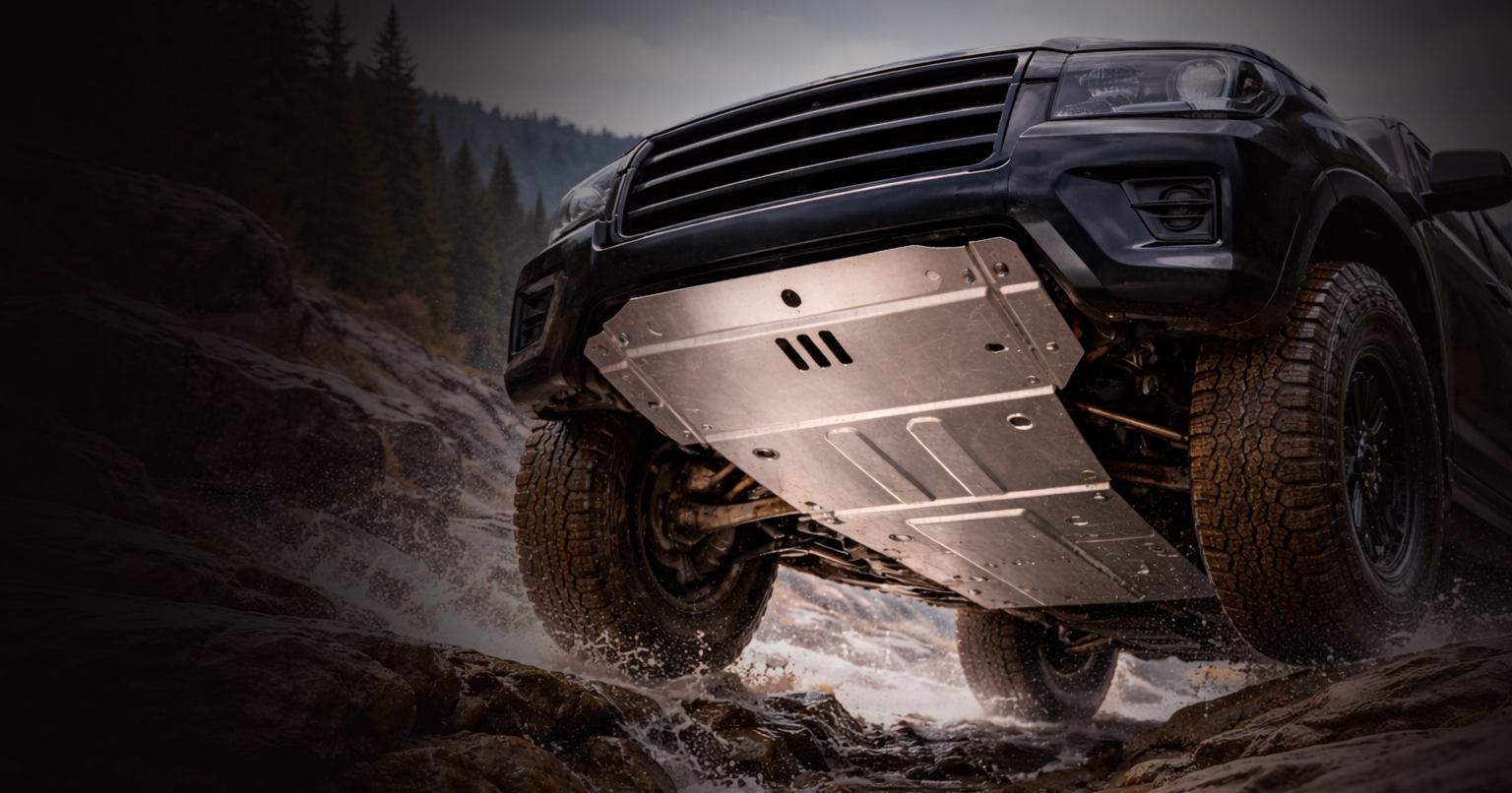
Driving on Gravel Roads: Which Underbody Parts Need Protection?
Gravel roads are not automatically off-road, but they expose the underside of a vehicle to hazards that are uncommon on smooth asphalt. Loose stones, deep ruts, raised sections and hidden holes can strike low-mounted components even when the vehicle is driven carefully.
The right underbody protection for gravel roads depends on the vehicle’s ground clearance, drivetrain and the position of vulnerable components. Some cars only need engine protection, while others benefit from additional gearbox, radiator, transfer-case, fuel-tank or differential guards.
What Can Damage a Vehicle on a Gravel Road?
There are two main types of risk: repeated stone impacts and direct contact with the road surface.
- Loose stones can strike the oil pan, gearbox housing, lower underbody areas and exposed pipes or brackets.
- Deep ruts can bring the centre of the vehicle into contact with raised gravel or compacted soil.
- Large embedded stones can cause a concentrated impact instead of a light surface strike.
- Hidden holes and washouts can compress the suspension and temporarily reduce ground clearance.
- Raised centre sections can affect the gearbox, transfer case, exhaust or fuel tank after the front wheels have already passed safely.
A factory plastic undertray can help manage airflow, dirt and minor splashes, but it should not automatically be treated as impact protection.
Which Underbody Parts Should You Protect First?
| Priority | Component | Main gravel-road risk |
|---|---|---|
| 1 | Engine and oil pan | Direct impact from stones, holes and raised ground |
| 2 | Gearbox or transmission | Contact with ruts and obstacles under the centre of the vehicle |
| 3 | Lower radiator area | Stone impacts and contact with raised road surfaces |
| 4 | Transfer case and differential | Exposure on AWD and 4×4 drivetrains |
| 5 | Fuel tank or AdBlue tank | Rear or centre-underbody contact on deep, uneven tracks |
1. Engine and Oil Pan Protection
The engine area is normally the first place to inspect. An exposed oil pan can be damaged by a concentrated impact, potentially causing an oil leak and making it unsafe to continue driving.
An engine skid plate creates a metal barrier beneath the lower engine area. Depending on the vehicle, it may also cover part of the front subframe, oil-filter area or factory undertray position.
For occasional gravel-road use, engine protection may be sufficient when the other major components sit higher or already have adequate factory protection. Our comparison of an engine skid plate versus wider underbody protection explains when additional coverage is justified.
For a vehicle-specific example of combined front protection, see the 2 mm steel Toyota RAV4 engine, front bumper, gearbox and radiator skid plate, which covers several exposed front-underbody zones in one application for selected 2018–2026 vehicles.
2. Gearbox and Transmission Protection
The gearbox is usually positioned behind the engine. This makes it vulnerable to obstacles that pass under the front of the vehicle but contact the underside farther back.
Gearbox protection becomes more important when:
- the transmission housing or oil pan sits low;
- the road has deep wheel tracks or a raised centre;
- the vehicle is heavily loaded;
- gravel-road driving is frequent rather than occasional;
- the vehicle is a van, SUV, pickup or work vehicle.
See our guide to gearbox and transmission protection for a more detailed assessment of this area.
For dedicated centre-drivetrain protection on a 4×4 application, the Toyota Land Cruiser 250 3 mm steel gearbox and transfer-case skid plate protects the gearbox and transfer-case area on the listed 2024–2026 vehicle application.
3. Radiator and Lower Front Protection
The radiator itself may sit higher than the oil pan, but its lower mounting area, hoses and surrounding components can still be exposed through the lower front section of the vehicle.
Radiator-area protection deserves priority when the vehicle has limited factory shielding, low-mounted components or regular exposure to rough gravel roads, raised surfaces and larger stones.
Coverage varies considerably between models, so the product description must confirm whether a skid plate protects the radiator area, engine area or both.
For a detailed explanation of when this protection zone is worth adding, see our radiator skid plate guide, covering lower-front exposure from gravel, potholes, winter roads and rough surfaces.
For a vehicle-specific example, see our Mitsubishi ASX underbody protection guide, which compares the 2010–2022 engine and gearbox skid plate with the 2023–2026 version that also includes radiator protection.
If you want to decide which protection zone should come first on the Mitsubishi ASX, see our Mitsubishi ASX protection priorities guide, covering the engine, gearbox and radiator area by model year.
For a Mitsubishi ASX-specific guide to gravel, potholes, broken asphalt, snow and frozen winter ruts, see our Mitsubishi ASX underbody protection guide for potholes, gravel and winter roads.
For a vehicle-specific example with multiple generations, 4×2 and 4×4 drivetrains, fuel-tank, rear-differential and Hybrid battery protection options, see our Dacia Duster skid plate guide by generation.
4. AWD and 4×4 Drivetrain Components
AWD and 4×4 vehicles can have additional components underneath, including a transfer case, prop shaft and front or rear differential. These parts are not necessarily protected by an engine or gearbox plate.
Additional drivetrain protection is worth considering when the vehicle regularly travels on:
- deeply rutted gravel roads;
- forestry or agricultural tracks;
- construction-site access roads;
- routes with exposed stones or raised centre sections.
A plate should only be ordered for the exact drivetrain configuration. A front-wheel-drive version and an AWD version of the same model may have different underbody layouts and mounting points.
For a more detailed explanation of when front or rear differential protection is useful, see our differential skid plate guide, including drivetrain-specific fitment, deep ruts, gravel roads and rough-road exposure.
For a 4×4-specific example, see our Jeep Wrangler JL skid plate guide. It explains why engine protection comes first and how a separate transmission plate extends coverage beneath the central drivetrain area for gravel roads, deep ruts, rocky trails and overlanding use.
5. Fuel Tank and Other Rear Components
Fuel-tank protection is not automatically necessary for every gravel-road vehicle. It becomes more relevant when the tank is exposed, the road surface is deeply uneven or the vehicle frequently carries a heavy load.
The same principle applies to AdBlue tanks, exhaust components and rear drivetrain parts: inspect their position first and protect them according to actual exposure rather than trying to cover every available zone.
For a more detailed explanation, see our guide on when fuel-tank protection is worth it.
Steel or Aluminium for Gravel Roads?
Both materials can be suitable, but they serve different priorities.
- Steel is generally preferred for repeated hard impacts, heavy vehicles, rocky tracks and demanding work use.
- Aluminium reduces added weight and can be suitable for normal-road driving combined with occasional gravel roads or moderate touring.
Thickness alone does not determine protection strength. Plate geometry, reinforcement, mounting design, coverage and material grade also matter.
Read the full steel versus aluminium skid plate comparison before choosing.
Recommended Protection by Vehicle Use
| Vehicle use | Recommended starting point |
|---|---|
| Occasional maintained gravel road | Engine and oil-pan protection |
| Regular rural or gravel-road driving | Engine plus gearbox protection |
| Low-clearance vehicle | Inspect engine, gearbox and lower radiator area |
| AWD crossover or SUV | Engine and gearbox, then inspect transfer case and differential |
| Pickup, van or loaded work vehicle | Broader protection based on exposed drivetrain and tank areas |
| Rocky, deeply rutted or construction access road | Broader protection for exposed critical components |
For a crossover-specific example, see our Suzuki S-Cross underbody protection guide, which explains how to prioritise engine, gearbox, radiator and differential protection according to model year, drivetrain and road use.
For a pickup-specific example covering work sites, towing, gravel roads and rough-road use, see our Ford Ranger skid plate guide, which explains how to prioritise engine, radiator, gearbox, transfer-case, fuel-tank, DPF and rear-differential protection by vehicle use and configuration.
Check the Vehicle Before Ordering
Do not select a skid plate by vehicle name alone. Confirm the model year, engine, transmission and drivetrain. Different versions of the same model can use different subframes, exhaust layouts and mounting points.
Also check exactly which zones each product covers. Terms such as “engine plate”, “gearbox plate” and “complete set” should be verified against the listed protection areas and number of plates.
You can browse available vehicle-specific skid plates and underbody protection or contact us with the VIN if compatibility requires confirmation.
Inspection After Gravel-Road Driving
After a hard impact, stop in a safe place and check for warning lights, fluid leaks, unusual noises or visible hanging parts. Do not continue driving if there is evidence of oil, coolant, fuel or transmission-fluid loss.
Skid plates and their mounting points should also be inspected periodically. Check for loose fasteners, strong deformation or direct contact between the plate and a protected component.
For related road-damage scenarios, see our pothole and underbody damage guide, which explains how deep road defects can affect the oil sump, gearbox and other low-mounted components.
If you also drive in snow, ice and salted winter conditions, read our winter underbody protection guide for additional risks from frozen ruts, compacted snow, moisture and road salt.
Conclusion
For most vehicles used on gravel roads, the engine and oil pan are the first protection priority. Gearbox and radiator protection should follow when those areas are exposed. AWD and 4×4 vehicles may also need transfer-case or differential protection, while fuel-tank protection depends on the vehicle layout and road severity.
The correct setup is not the largest available kit. It is the vehicle-specific combination that protects the components most likely to contact stones, ruts and raised ground.
